
Nirma University Journal of Business and Management Studies


Harsh Pratap Singh1 , Omkar Sahoo1 and Pratham Parekh1
1Institute of Management, Nirma University, Ahmedabad, Gujarat, India

This article is distributed under the terms of the Creative Commons Attribution-NonCommercial 4.0 License (https://creativecommons.org/licenses/by-nc/4.0/) which permits non-commercial use, reproduction and distribution of the work without further permission provided the original work is attributed as specified on the SAGE and Open Access page (https://us.sagepub.com/en-us/nam/open-access-at-sage).
The growing adoption of compressed natural gas (CNG) vehicles in India is driving demand for efficient, financially viable CNG infrastructure. This case examines CityGrid Gas Limited’s (CGGL) investment decision for establishing a CNG station at Abu Road, Rajasthan. CGGL is evaluating two alternatives: a daughter booster (DB) station supplied through mobile cascades and an online station connected directly to the existing gas pipeline network. The case evaluates these alternatives considering capital investment, operating costs, demand growth, financing, taxation, depreciation, station capacity, and long-term infrastructure requirements. It also examines each alternative’s strategic flexibility and scalability, as CNG demand is expected to increase significantly. The case enables learners to apply capital budgeting techniques while integrating financial and non-financial considerations in infrastructure investment decisions.
Financial feasibility, capital budgeting, cash flow analysis and net present value (NPV)
During the recent review meeting, Bhavesh, the Executive Vice President of Operations at CityGrid Gas Limited (CGGL), provided an overview of the performance of CGGL’s compressed natural gas (CNG) station. Referring to an industry report published in May 2026, he highlighted that CNG vehicle adoption in India increased by 40.7% from May 2025, despite a 45% increase in CNG prices over the last 2 years. This shift in consumer preference towards cleaner and more cost-effective transport options has forced automakers to offer CNG-powered vehicles in the Indian passenger vehicle market. Bhavesh further added that the increase in CNG-powered vehicles on the road will require more and more efficient CNG fuel stations to support this expanding demand in India.
Supporting Bhavesh’s claim, Pankaj, the head of CGGL’s CNG division, advised that we also need to expand our infrastructure to meet rising CNG consumption in a cost-effective, financially viable way.
CityGrid Gas Limited: Background
CGGL, one of the leading city gas distribution companies in India, primarily operates in four states: Maharashtra, Gujarat, Rajasthan and Haryana. It has further planned to expand its operations in Punjab and Madhya Pradesh in recent years. CGGL operates in four key verticals: piped natural gas (PNG)-domestic, PNG-commercial, PNG-industrial and CNG stations. As of 31 March 2024, the company has a network of 640 CNG stations, serving 15.5 lakh+ households, 12,900 commercial customers and 6,300 industrial customers.
Compressed Natural Gas Station Division of CityGrid Gas Limited
CGGL has a vast network of 640 CNG stations in four states, with a major presence in Gujarat. The Gujarat operations are further classified into four clusters: Saurashtra (217 CNG stations, 106 daughter booster [DB] stations, 27 mother stations and 84 online stations), Central Gujarat (109 CNG stations), South Gujarat (184 CNG stations) and North Gujarat (34 CNG stations). Outside Gujarat, CGGL has a very limited network, with 33 CNG stations in Maharashtra, 43 in Rajasthan and 20 in Haryana.
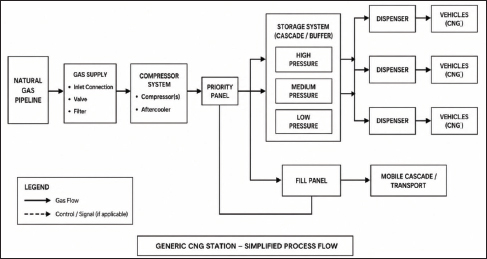
CGGL’s CNG division operates through its network of mother CNG stations, DB CNG stations and online CNG stations. A mother station is one that is directly connected to the gas grid and supplies CNG to DB stations. Figure 1 and Figure 2 illustrates the operating process of a mother CNG station and DB CNG Station respectively. A mother station is usually located near a natural gas supply pipeline and supplies CNG to its nearby DB stations in mobile cascades. CGGL usually has 2-3 mother stations in each district and supplies around 15-20 DB stations. The operations of the online CNG station and mother CNG stations are similar, except that the online CNG station is used for retail fuelling only. However, it can be converted to a mother station by installing a mobile cascade fill panel.
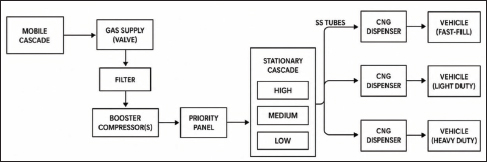
In areas where an underground gas pipeline is unavailable, CGGL operates through its DB CNG stations. For these stations, gas is supplied via a mobile cascade from a mother station. Gas is compressed by a booster compressor and stored in a stationary cascade at the DB CNG station. This operational model allows for efficient gas distribution and vehicle refuelling in locations where underground pipeline infrastructure is not feasible or economically viable. Unlike the online/mother CNG station, the DB station requires minimal infrastructure. The capital requirement for land is also much lower in a DB station than that for an online CNG station. However, the transportation expenses at the DB station are much higher than those at the online station. These costs include trailer packages, trucks, fuel and driver salaries, collectively impacting the station’s operational expenses. In contrast, mother/online stations necessitate substantial investments in gas pipeline infrastructure, including initial installation and ongoing maintenance. Pipelines are designed to last 20 years per industry standards, with mandatory hydraulic pressure testing every 3 years to ensure safety and operational integrity.
CityGrid Gas Limited’s Expansion Plan for Compressed Natural Gas Stations
To keep up with the growing demand for CNG vehicles, CGGL plans to expand its CNG station network. CGGL plans to develop a new CNG station at Abu Road, approximately 46 km from its existing mother CNG station in Pindwara, Sirohi, Rajasthan. CGGL is evaluating two options for developing a CNG station at the Abu Road location, with an estimated life of 20 years:
DB CNG station: In this option, CGGL is required to establish a DB CNG station at Abu Road. DB stations will receive CNG supply from the mother CNG station at Pindwara.
Online CNG station: Alternatively, CGGL is considering establishing an online CNG station at Abu Road. Online CNG stations are directly connected to the main supply pipeline originating from the mother CNG station at Pindwara.
CGGL is evaluating both options based on financial and operational criteria to optimise the expansion of CGGL’s CNG network in Abu Road and its vicinity. The head of the CNG division, along with the finance and sales departments, collected pertinent financial, operational and market data to support informed decision-making. As per the forecast submitted by the sales department, demand for CNG in the Abu Road area is expected to remain around 7,000 kg per day for the first 5 years, then increase to 15,000 kg per day and remain at 15,000 kg/day thereafter. This increase in CNG demand will require CGGL to install more CNG stations in the area. The current sales price of CNG in the area is ₹81 per kg and is expected to increase at an annual growth rate of 3%. The DB CNG station can practically dispense a maximum of 5,000 kg of CNG per day, whereas the online station can dispense a maximum of 6,000 kg per day. The advantage of installing an online station is that it provides flexibility, allowing CGGL to convert it into a mother station to supply CNG to other DB stations to be installed in the area in the future by adding an external fill panel. However, to install an online CNG station, a 12″ underground carbon steel gas pipeline spanning 48 km must be laid from Pindwara Station. This pipeline requires an investment of ₹7,000,000 per km to cover labour, civil work and piping costs. The estimated lifespan of this pipeline is 20 years, with annual maintenance. Apart from this, investment is also required for stationary cascades, mobile cascades, unloading panel, cascade filling systems, electrical connections and fittings, hose pipes, valves, couplings, breakaway devices, gas detectors, booster compressor and CNG dispensers. All these assets have a lifespan of 20 years, with annual maintenance. The depreciation on all these assets is calculated using the straight-line method. The financing of these assets will be done through a bank loan at an annual interest rate of 9%. CGGL also pays a 30% tax on its profit. The detailed financial data on the operating expenses of both the DB station and the online station are presented in Exhibit 1. Additionally, Exhibit 2 provides information on the capital expenditure requirements for establishing both the DB station and the online station.
| Daughter Booster Station | ||
| Expenses Category | Incidence of Cost | Amount |
| 1. Power Charges | ||
| a. For CNG boosting and dispensing | Charges incurred based on per kg of CNG dispensed and boosted | ₹1.5 per kg of CNG dispensed and boosted |
| b. For general lighting and air conditioning | Fixed for the period | ₹120,000 per year |
| 2. Gas transportation charges via mobile cascades | Charge incurred based on per kg of CNG transported | ₹7 per kg of CNG transported |
| 3. Human resources charges | 4 operators @ ₹500 per day | ₹110,000 per month |
| 4. Fixed maintenance charges for station equipment | A yearly maintenance agreement can be executed at a rate of ₹120,000, covering comprehensive maintenance services. The contract is subject to renewal with an annual increase of 2% | |
| 5. Procurement of natural gas | Including all expenses till procurement | ₹31 per kg of CNG procured |
| Online Station | ||
| Expenses Category | Incidence of Cost | Amount |
| 1. Power Charges | ||
| a. For CNG boosting and dispensing | Charges incurred based on per kg of CNG dispensed and boosted | ₹1 per kg of CNG dispensed and boosted |
| b. For general operations and air conditioning | ₹120,000 per year for general operation and air conditioning | |
| 2. Fixed maintenance charges for station equipment | A yearly maintenance agreement can be executed for ₹120,000, covering comprehensive maintenance services. The contract is subject to renewal with an annual escalation of 2% | |
| 3. Human resources charges | 4 operators @ ₹500 per day per operator | ₹110,000 per month |
| 4. Annual maintenance of high-pressure underground gas pipeline. | A yearly maintenance agreement can be executed at a rate of ₹200,000 and covers comprehensive maintenance services. The contract is subject to renewal with an annual escalation of 2% | |
| 5. Procurement of natural gas | Including all expenses till procurement | ₹31 per kg of CNG procured |
Note: All the charges, including power charges, gas transportation charges, human resources charges and procurement of natural gas, are expected to increase @ 2% per annum due to inflation.
| Components | Specification for Daughter Booster | Expected Cost (in ₹) | Specification for Online | Expected Cost (in ₹) |
| Land requirements | A plot of 1,000 m2 with a minimum frontage of 25 m | 7,000,000 | A plot of 1,500 m2 with a minimum frontage of 35 m | 13,000,000 |
| Underground gas pipeline | Not required | Nil | 12″ carbon steel gas pipeline for 48 km @ ₹7,000,000 per km labour, civil work and piping cost | 336,000,000 |
| Stationary cascades | The 4,500 WL cascade, which is 60 cylinders of 75 water litres each, can store 530 kg | 3,500,000 | A 3,000 WL cascade, which is 40 cylinders of 75 water litres each, can store 530 kg | 2,000,000 |
| Mobile cascade | 4,500 WL cascade, which is 60 cylinders of 75 water litres, can store 530 kg | 3,500,000 | Not required | Nil |
| Unloading panel | 1 unloading panel is required | 2,000,000 | Not required | Nil |
| Cascade filling systems | 3 pipe filling system | 1,200,000 | 3 pipe filling system | 1,200,000 |
| Electricity connection and fitting | 1,800,000 | 1,800,000 | ||
| Hose pipes, valves, couplings, breakaway devices and gas detectors | 1,500,000 | 1,500,000 | ||
| Booster compressor | 1,800,000 | 1,800,000 | ||
| CNG dispenser specification | 3 CNG dispensers with a maximum instant flow capacity of 15 kg/min @ ₹500,000 per CNG dispenser | 15,000,000 | 3 CNG dispensers with a maximum instant flow capacity of 15 kg/min @ ₹500,000 per CNG dispenser | 15,000,000 |
Note: The straight-line depreciation method is applicable to all capital assets with a useful life of 20 years and a zero-salvage value.
Discussion Questions
Should CGGL set up a DB station or an online station at Abu Road? Which option creates more value financially, and why?
With demand expected to grow from 7,000 to 15,000 kg/day, which type of station is better suited to handle future demand, and why?
Should CGGL adopt a phased approach (starting with DB stations and later upgrading) or invest upfront in online infrastructure? Justify your recommendation.
What are the non-financial considerations involved in the investment decision of establishing a DB CNG station or online CNG stations?
The authors declared no potential conflicts of interest with respect to the research, authorship and/or publication of this article.
The authors received no financial support for the research, authorship and/or publication of this article.
Harsh Pratap Singh https://orcid.org/0000-0002-4634-164X
