
Nirma University Journal of Business and Management Studies


Mahak Saklecha1 and Ruchi Sao1
1Institute of Management, Nirma University, Ahmedabad, Gujarat, India

This article is distributed under the terms of the Creative Commons Attribution-NonCommercial 4.0 License (https://creativecommons.org/licenses/by-nc/4.0/) which permits non-commercial use, reproduction and distribution of the work without further permission provided the original work is attributed as specified on the SAGE and Open Access page (https://us.sagepub.com/en-us/nam/open-access-at-sage).
The representation of Generation Z (Gen Z) employees in the global workforce has encouraged scholars in this field. Yet, the research on workplace adaptation among Gen Z remains fragmented. This study presents an integrative review of the literature on Gen Z in organizational contexts to synthesize existing knowledge and identify prevalent themes. The study includes a review of 50 Scopus-indexed articles. The PRISMA guidelines were followed for the review. Eight prevalent themes were synthesized from the literature. Based on person-organization fit theory, an Integrated Gen Z Workplace Adaptation Framework is proposed to help align the Gen Z workplace profile with organizational practices and processes. The framework proposes that alignment can lead to engagement, performance, and retention. The review also critically evaluates the current literature and provides a research agenda for future research. Practical implications are discussed for human resource practitioners, leaders, and organizational practices and processes. The findings imply that Gen Z employees strongly value flexibility, continuous learning, meaningful work, psychological safety, and supportive leadership. Overall, this review advances theoretical understanding of Gen Z in the workplace and offers actionable insights for organizations seeking to adapt to Gen Z employees in the workplace.
Gen Z, workplace expectations, employee engagement, person-environment fit, workplace adaptation
Introduction
The contemporary workplace consists of several generations. Gen Z is the newest cohort in the workplace. People born after 1995 and before 2010 are referred to as Gen Z (Chillakuri, 2020; Ensari, 2017; Maloni et al., 2019; Rosen, 2010). Each generation comes with similarities and differences in the workplace (Arora et al., 2020; Taslim et al., 2026). Gen Z differs from previous ones in several aspects (Ngobeni et al., 2026). Gen Z has different work values and motivations from previous generations (Dania et al., 2023; Maloni et al., 2019). Due to these differences, existing leaders and managers are facing significant problems managing Gen Z. Furthermore, Gen Z has experienced pandemics such as COVID-19, wars, and the rise of artificial intelligence (AI), which have shaped their workplace behavior. The report published in McKinsey Quarterly (McKinsey & Company, 2025) highlighted a few crucial points, such as “It is indispensable to understand the workplace characteristics of Gen Z, as by 2025, a quarter of the global workforce will be composed of Gen Z.” The report notes that the influence of mental health on Gen Z’s performance is greater than that of previous generations. Additionally, Gen Z is often described as more techno-savvy than former generations (Szymkowiak et al., 2021), and their learning approach is evolving; they are more inclined toward digital learning and possess greater digital capabilities (Ru-Zhue, 2025). Gen Z and previous generations are significantly different. Therefore, it is urgent to better understand Gen Z to integrate them smoothly into the organization. Lack of understanding regarding Gen Z will lead to stereotypes and bias against them (DeArmond et al., 2006).
There is increasing research that focuses on understanding Gen Z expectations, values, behavior, and engagement in the workplace (Arnold & O’Brien, 2025; Barhate & Dirani, 2022; Loring & Wang, 2022; Maan & Srivastava, 2023; Nguyen & Petchsawang, 2026; Waworuntu et al., 2022). The existing reviews of Gen Z fail to provide comprehensive guidance to practitioners and scholars. Moreover, the existing literature assumes that there is something wrong with Gen Z as a population. This assumption leads to the conclusion that the Gen Z workforce needs to change their workplace behavior. This creates a void in the organization’s responsibilities for integrating Gen Z into the workplace. The present study challenges this assumption, provides an adoption mechanism for the organization, and compels organizations to adopt as well. Moreover, scholarly interest is increasing in the area of Gen Z and the workplace. But the literature in this area is not concentrated and is fragmented across domains. The theories are also not unified. All these lead to obstacles in the comprehensive understanding of Gen Z in the workplace. Therefore, without an integrated review and framework, the understanding of this phenomenon is incomplete. To understand the phenomenon, the following questions are proposed:
What are the prevalent characteristics and expectations of Gen Z employees?
Which organizational processes and practices most effectively retain and engage Gen Z employees?
How does Gen Z differ in terms of values and motivations, compared to those of earlier generations?
What are the contextual factors that shape their workplace attitude and behavior?
To address this gap, the present study conducts a systematic literature review on Gen Z in the workplace. To understand the facts and opinions about the Gen Z workplace, we conduct this review and synthesize the existing literature on it. This review provides a holistic understanding of Gen Z workplace behavior and an integrated model that clarifies employee expectations, values, and their organizational implications. There are four major objectives:
To identify what themes, methods, and theories are prevalent in Gen Z workplace literature.
To synthesize findings regarding Gen Z workplace behaviors and generate themes.
To develop an integrative conceptual framework that helps organizations align the Gen Z workplace profile and organizational processes and practices.
To conduct a critical evaluation of existing literature on Gen Z workplace behavior.
Theoretical Contribution
This review’s central novelty is a shift in orientation regarding efforts to integrate Gen Z into the workplace: rather than adding a further descriptive account of “what Gen Z wants,” it synthesizes 38 studies into an Integrated Gen Z Workplace Adaptation Framework (IGZWAF), grounded in person-organization fit theory (Schneider, 1987), that specifies the mechanism of alignment between the Gen Z profile and organizational practice, through which workplace outcomes are produced. This process-oriented, three-stage structure, rather than an additional list of generational traits, constitutes the study’s primary theoretical contribution. Theoretically, it moves the literature from fragmented, variable-based studies toward a holistic, mechanism-based understanding of Gen Z behavior; the review also critically reconciles contradictory findings and contextual contingencies that prior single-theme reviews have not addressed. In practice, the review translates the same three-stage logic into a sequence of implications for managers, leaders, and human resource (HR) practitioners that is explicitly keyed to the evidence base underlying each recommendation, rather than being offered as generic advice.
The remainder of the article is structured as follows. First, the methodology is outlined. Second, findings from the literature, including cross-cutting contradictions and contextual contingencies, are presented. Third, the integrated model is proposed. Finally, a critical evaluation of the literature, the review’s own limitations, practical implications, and a conclusion are discussed.
Methodology
This study adopted an integrated systematic literature review to synthesize existing literature on Gen Z in the workplace. An integrative review is particularly appropriate when the aim is to synthesize findings from varied theoretical frameworks and methodological approaches to develop an understanding of a phenomenon (Tranfield et al., 2003). This technique facilitates the synthesis of empirical, conceptual, qualitative, and quantitative studies into an integrated body of knowledge, addressing the fragmented nature of Gen Z literature (Torraco, 2016). The review followed a rigorous, transparent, and replicable methodology in accordance with accepted protocols for systematic reviews as prescribed in PRISMA (Page et al., 2021).
Search Strategy
A search strategy was developed to capture peer-reviewed Scopus-indexed journal articles on Gen Z in organizational and workplace contexts. The Scopus database was used to ensure broad coverage. Scopus is recognized as one of the largest and most comprehensive multidisciplinary bibliographic databases, which provides broader journal coverage than Web of Science and more structured indexing than Google Scholar (Falagas et al., 2008; Mongeon & Paul-Hus, 2016). Previously, studies have confirmed that Scopus provides wide coverage of high-quality peer-reviewed journals, robust citation tracking, and advanced filtering options, making it particularly suitable for systematic and bibliometric reviews (Martín-Martín et al., 2018).
Consistent with recommended integrative review practice (Whittemore & Knafl, 2005), the search was deliberately restricted to this single, high-coverage database rather than being run across multiple databases. This reflects a considered trade-off rather than an oversight: for a tightly bounded population, which is Gen Z specifically, in workplace or organizational contexts specifically, a single, consistently indexed database reduces duplicate and low-quality records at the cost of the broader (but noisier) coverage that multi-database searches provide. The authors treat this as an explicit boundary condition of the review; its implications for the generalizability of the synthesis are discussed in Section “Limitations of Existing Literature and Future Research”, and multi-database replication is proposed as a specific direction for future research.
The following keywords were used to retrieve the data: “Gen Z,” “Generation Z,” and “Workplace.” The review concentrated on research published from 2017 to 2025. This timeframe was chosen for two reasons: Academic focus on Gen Z as a working demographic increased notably after 2017, with the major entry of Gen Z into full-time employment. Concentrating on this timeframe ensured the study reflected current organizational dynamics, including post-COVID-19 workplace changes such as hybrid work, digitization, and evolving employment expectations.
Inclusion and Exclusion Criteria
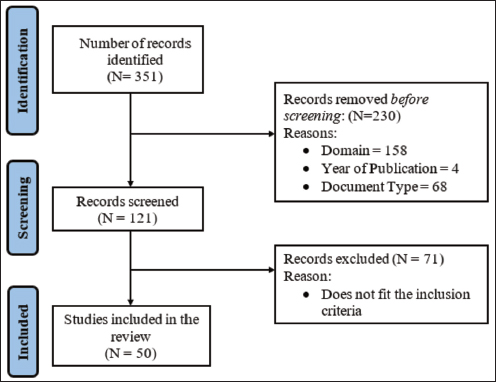
The screening process was conducted in multiple stages (Figure 1). First, the database search generated an initial pool of 351 articles based on keywords. Second, to ensure that only relevant studies were available for review, we developed inclusion and exclusion criteria. Only those studies were included that were from the domain of business and management, focused primarily on Gen Z as the target population, examined issues related to the workplace, employment, or organizational behavior, were published in peer-reviewed academic journals, and were written in English. Studies were excluded if they were focused solely on Millennials or mixed generations without a specific analysis of Gen Z; addressed Gen Z only in educational or consumer behavior contexts; or were conference papers, book chapters, theses, or non-peer-reviewed reports. After applying inclusion and exclusion criteria, a pool of 121 articles remained. Third, articles were screened manually for relevance based on titles and abstracts. Studies that did not clearly address Gen Z in workplace or organizational contexts were removed. After eliminating irrelevant studies, a final sample of 50 peer-reviewed articles was retained for in-depth analysis.
Data Extraction and Coding
The systematic extraction and coding of the literature were conducted, and as a result, a matrix was developed. The following heads were used to classify the information from the literature: author(s) and year of publication, journal and disciplinary focus, country or context of study, research objectives, theoretical framework(s), key constructs examined, methodology and sample characteristics, major findings, practical implications, limitations, and future research directions. This coding process enabled cross-study comparison and facilitated the identification of recurring patterns, convergences, and contradictions in the literature.
To strengthen coding reliability, the first author coded all 38 studies against this matrix, and the second author independently re-coded a purposive subset of the sample and cross-checked the resulting thematic groupings; discrepancies in category placement or theme labels were resolved through discussion until consensus was reached. This two-reviewer verification step, while more limited than full dual-independent coding of the entire sample, was intended to reduce single-coder bias in theme construction. The authors note this explicitly as a methodological boundary condition rather than a completed inter-rater reliability test, and recommend that future reviews in this stream report a quantitative reliability statistic (e.g., Cohen’s kappa) computed across the full sample.
Theme Synthesis and Analysis
The analysis followed an iterative thematic synthesis approach. After coding all studies, comparison techniques were used to analyze the data and identify themes from the extracted data. The synthesis process involved creating a mind map that grouped studies by common research topic, identified dominant theoretical perspectives, and mapped methodological trends. The analysis resulted in themes presented in the next section.
Findings and Themes
Characteristics of Gen Z Employees
A major part of the existing literature has been dedicated to studying the characteristics of Gen Z. Growing up with smartphones, Gen Z has been described as more tech-savvy and as digital natives (Chillakuri, 2020; Lazányi & Bilan, 2017). These extreme uses of technology and exposure have shaped future preferences for hybrid work, instant feedback, and rapid communication.
The prevalent characteristics of Gen Z are highly independent, practical, and entrepreneurial, and Gen Z employees demonstrate a stronger inclination toward autonomy, ongoing education, and personal growth compared to millennials and previous generations (Chillakuri & Mahanandia, 2018). Nonetheless, they demonstrate diminished organizational loyalty and keen employer demands. The existing literature challenges common stereotypes that portray Gen Z as disengaged or unprofessional. Studies suggest that their level of commitment is not necessarily lower; rather, it depends on various factors (Nguyen & Petchsawang, 2026). They expect transparency, authenticity, inclusiveness, respect, and meaningful work to be essential for their engagement (Janssen & Carradini, 2021; Kataria et al., 2026). Therefore, Gen Z should be understood as a cohort that has differing expectations regarding technology, flexibility, communication, and psychological safety.
Work Values and Career Priorities of Gen Z
One of the most extensively researched strands addresses the work values and priorities of Gen Z employees. Several studies have explored the concerned topic in different settings, and findings are more or less similar to each other. Arora et al. (2020), Maloni et al. (2019), and Pataki-Bittó and Kapusy (2021) contribute to identifying dominant work values: work-life balance, continuous learning and development, job security and stability, flexibility, autonomy, positive social relationships, and meaningful work (Nguyen & Petchsawang, 2026).
There are priorities among Gen Z that differ from those of previous generations (da Silva Sousa & Douglas Colauto, 2021). Preference for compensation is the same across the generations. The main differences lie in personal growth, flexibility, less hierarchy, and well-being, where Gen Z is more sensitive to these aspects than previous generations (Barhate & Dirani, 2022; Egerová et al., 2021). De Boer and Bordoloi (2022) argue that cross-national studies and many work values are culturally specific, although Gen Z employees have intrinsic motives and values that drive them to contribute significantly, grasp opportunities, and foster learning and observable outcomes that are universally valid.
Workplace Expectations and Psychological Contracts
Different workplace expectations are a major phenomenon unraveling across the literature. The new workplace expectations aim to foster new forms of psychological contract with the organization, including the following: transparent leadership, frequent feedback, hybrid work opportunities, friendship, respectfulness, and inclusivity (Egerová et al., 2021; Jaya et al., 2026; Maloni et al., 2019; Zhou et al., 2026).
Unlike previous generations, Gen Z is more serious about their demands. Studies from Romania and central Europe demonstrated that unmet expectations are strongly associated with dissatisfaction and turnover intentions among Gen Z (Botezat et al., 2023; De Boer & Bordoloi, 2022; Egerová et al., 2021). After COVID-19, hybrid workplace has become the most nonnegotiable demand for Gen Z (Osorio & Madero, 2025). Gen Z assesses employers from a transactional, expectation-centric, social, and legal perspective; when firms fail to meet these expectations, psychological disengagement occurs swiftly, and Gen Z is likely to engage in moonlighting (Bhore et al., 2025).
Motivation, Engagement, and Retention Drivers
A body of research focuses on the retention and motivation of Gen Z. Across industries, several consistent drivers of engagement are revealed: a supportive environment, recognition, learning, autonomy, a skill-role match, fairness, and justice. Chillakuri (2020) and Kgarimetsa and Naidoo (2024) found that supervisor support significantly moderates turnover intentions, particularly when employees experience boredom or unmet expectations. Similarly, for retention, recognition and flexibility are the main antecedents in the mining and banking industries (Brown, 2025; Kgarimetsa & Naidoo, 2024).
Unlike previous generations who are motivated by pay or status, Gen Z employees seek holistic motivational packages that combine financial, developmental, moral, and psychological elements (Botezat et al., 2020; Krishna & Agrawal, 2024; Nguyen & Petchsawang, 2026). Moreover, the retention of Gen Z talent is influenced more by daily managerial assistance, feedback, and meaningful engagement than by conventional loyalty programs (Ignatius Soni Kurniawan et al., 2026; Peemanee et al., 2026). For example, a study was conducted in the Jordanian context, which revealed that Gen Z demands a combination of financial, social, and emotional factors that can ensure their financial-emotional well-being and interpersonal relationships (Al-Twal et al., 2025).
Organizational Support Mechanisms and Human Resource Practices
Scholars and researchers are consistently working toward the smooth integration of Gen Z into the organization. Organizational support and HR practices are major factors that can help achieve a smooth integration of Gen Z, increase satisfaction and career intentions in the workplace (Nguyen & Petchsawang, 2026; Pauli & Dudek, 2025; Tabi et al., 2025). The literature emphasizes the importance of structured onboarding, mentoring, coaching, frequent communication, experience, and development-oriented HR policies (Ngobeni et al., 2026; Pauli & Dudek, 2025).
Research on onboarding suggests that inductions that are structured, interactive, and feedback-rich are preferred more by Gen Z (Chillakuri, 2020). Furthermore, recent studies suggest increasing personalization in human resource management (HRM) by using AI technology and customized career paths (Thomas et al., 2025). Conventional uniform HR strategies are becoming progressively inadequate for Gen Z; tailored, development-oriented frameworks are essential (Pauli & Dudek, 2025).
Communication Preferences and Soft-skill Challenges
Gen Z has used digital communication aggressively and proficiently, yet several studies highlight problems in Gen Z’s interpersonal and professional communication (Visser & Terblanche, 2025). Janssen and Carradini (2021) report that despite being technically fluent, Gen Z employees often struggle with face-to-face communication, conflict management, and professional etiquette. A review of soft skills of Gen Z workers reveals that communication and cooperation are the most esteemed yet most lacking soft skills among Gen Z employees (Visser & Terblanche, 2025). Organizations are continuously working to develop soft-skill programs, coaching, and mentoring to address this issue (Visser & Terblanche, 2025). In the midst of a communication crisis, digital communication has played a significant role in maintaining work-life balance by providing opportunities for flexible work and increasing job satisfaction (Gunnoo et al., 2026).
The Post-COVID and Hybrid Work Context
The most recent literature examines how the COVID-19 pandemic influenced Gen Z’s workplace behavior. Studies from 2022 to 2026 indicate that hybrid and flexible work arrangements are strongly preferred by Gen Z, which has also resulted in retention (Kgarimetsa & Naidoo, 2024; Pauli & Dudek, 2025). Mental health and well-being have become pivotal concerns; flexibility is viewed as a central employment right, and personalized work experiences are increasingly anticipated (Taslim et al., 2026). The post-pandemic period has intensified Gen Z’s demand for independence, remote work opportunities, and technology-driven customization (Osorio & Madero, 2025). This increase in alternative work settings has shown mixed results for well-being, loneliness, and job satisfaction (Chmiel, 2025).
Cross-cutting Patterns in Literature
Beyond themes, several patterns emerged from the literature.
Methodological trends: Most studies are cross-sectional. Students are predominantly used as samples. Use of mixed methods has increased since 2022.
Theoretical trends: Several theoretical lenses are used to explain phenomena related to Gen Z—generational cohort theory, social exchange theory, self-determination theory, person-environment fit, theory of planned behavior, psychological contract, and organizational justice are the primary theories used in the literature.
Geographical trends: The literature spans the globe, from Europe to North America, the Subcontinent, and Australia. Still, the representation of underdeveloped countries is less.
Critical Analysis and Contradictions, Contextual Contingencies
The eight themes above indicate the pattern of convergence across literature. It is important to discuss the points of disagreement and the contextual contingencies that warrant explicit reconciliation rather than restatement.
Influence of culture on work values: Botezat et al. (2020) and Maloni et al. (2019) considered factors such as autonomy, growth, and meaningfulness immune to culture and generalized across cultures, whereas De Boer and Bordoloi (2022) showed that cross-cultural differences largely influence the prevailing work values, compensation, and preferences. The evidence from both studies together indicates that constructs such as “flexibility” and “meaningful work” do not hold the same connotation across cultures.
Industry-contingent retention drivers: The retention drivers for Gen Z differ across industries. In the IT sector, supervisory support was found to be the prime driver of retention (Chillakuri, 2020), whereas in the banking and mining sectors, the retention lever shifted toward recognition and flexibility (Brown, 2025; Kgarimetsa & Naidoo, 2024). This pattern suggests that Gen Z retention “levers” are not sector-invariant: in operationally rigid, on-site-heavy industries where locational flexibility is structurally limited, recognition and schedule autonomy appear to substitute for the autonomy that is more direct. Therefore, becomes more salient for knowledge workers.
Loyalty: a generational trait or a response? In the existing literature, there is a recurring question about Gen Z’s loyalty and commitment to the organization (Chillakuri & Mahanandia, 2018). There is another perspective that treats this as more of a response to unmet expectations (transparency, feedback, fair treatment) required to build strong psychological contracts. The assumptions regarding loyalty as a generational trait are unsupported. Therefore, low loyalty is better understood as an outcome of unmet organizational expectations than as a fixed generational trait.
Sample inappropriateness: A large number of studies used students as a sample to make conclusions for working employees (Arora et al., 2020; da Silva Sousa & Douglas Colauto, 2021; Maloni et al., 2019), while few used actual working employees (Ngobeni et al., 2026; Peemanee et al., 2026). These two evidence bases are frequently cited interchangeably in broader literature as though they were equivalent, yet pre-employment expectations and post-entry lived experience are conceptually distinct constructs; this review treats them as related but non-identical.
Geography and representativeness: The reviewed literature clusters in North America, Europe, and parts of the Indian subcontinent (Al-Twal et al., 2025, on Jordan; Taslim et al., 2026, on Oman), with East Asian, African, and Latin American organizational contexts comparatively underrepresented outside a small number of studies (Ngobeni et al., 2026, on South Africa). Claims about Gen Z workplace behavior, framed as broadly generalizable, therefore rest disproportionately on higher- and upper-middle-income country contexts, a boundary condition that the IGZWAF framework in section inherits.
An Integrated Model of Gen Z in the Workplace
One objective of the study is to translate and synthesize the findings into a coherent framework for a unified understanding of Gen Z adaptation in the workplace. The findings of the reviewed studies indicate that significant empirical work exists in the literature, but the findings are dispersed. Drawing on the themes identified in the literature, this review proposes an IGZWAF (see Figure 2) that explains how Gen Z characteristics interact with organizational practices to shape key workplace outcomes.
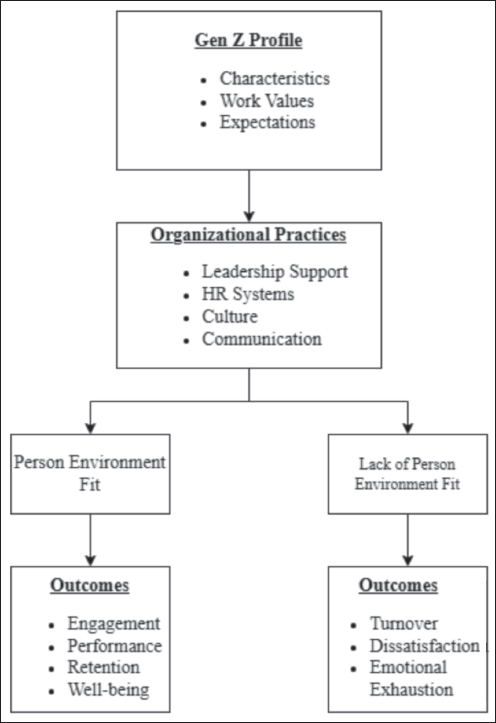
Drawing on person-environment fit theory, Schneider (1987) suggested that workplace outcomes for Gen Z are shaped by the degree of alignment between Gen Z’s characteristics and organizational responses. The model suggests organizational practices to make the organizational environment more adaptable for Gen Z instead of focusing on what is wrong with Gen Z. The themes identified suggest that effective management of Gen Z is not possible through traditional workforce assumptions and stereotypes. There is a need for greater digital communication with Gen Z to foster greater understanding. Subsequently, organizations need to reshape their practices. As the review pointed out, Gen Z has a high technological orientation, requires well-being, expects quick communication, challenges hierarchy, and prefers flexibility. Organizational success with Gen Z, therefore, depends on the alignment of organizational and HR practices with Gen Z workplace conduct (Saraiva & Nogueiro, 2025). The model proposes a three-stage process to explain the Gen Z workplace conduct and its outcomes. Three stages are:
Gen Z profile
Organizational practices and processes
Workplace outcomes.
Gen Z Profile
Gen Z has distinct characteristics, and in the workplace, expectations and values differ as well (Al-Twal et al., 2025). Table 1 outlines the characteristics, expectations, and values of Gen Z. Gen Z brings these aspects of their conduct to the workplace, and organizations must take them into account through practices and processes (Pauli & Dudek, 2025). Organizations must provide person-organization fit to these characteristics, work values, and workplace expectations (Taslim et al., 2026).
| Profile Aspect | Attributes |
| Characteristics | Digital nativity |
| Tech-dependent | |
| Less loyalty to the organization | |
| Prioritizes well-being | |
| Desire for autonomy | |
| Work values | Work–life balance |
| Continuous learning | |
| Job security | |
| Flexibility | |
| Meaningfulness | |
| Workplace expectations | Transparent leadership |
| Frequent feedback | |
| Hybrid workplaces | |
| Respectfulness | |
| Inclusivity |
Organizational Practices and Processes
In the second stage, all practices and processes must be shaped to ensure a smooth integration of Gen Z into the workplace, rather than challenging or questioning its expectations and values. The organizational practices and processes are listed in Table 2. If the organizational practices and processes line up with Gen Z’s prospects and values, the outcomes can be favorable (Pauli & Dudek, 2025). Empathetic leadership, inclusive leadership, supervisor support, reshaping organizational practices, culture, and communication have the potential to influence adaption and integration of Gen Z (Durman et al., 2026; Gunnoo et al., 2026; Janssen & Carradini, 2021; Ngobeni et al., 2026; Taslim et al., 2026).
| Practices and Processes | Attributes |
| Leadership and supervisor support | Empathetic leadership |
| Coaching-oriented supervision | |
| Open communication | |
| HR systems and policies | Structured onboarding |
| Mentoring program | |
| Transparent performance systems | |
| Personalized career paths | |
| Development opportunities | |
| Work design and flexibility | Hybrid and remote work |
| Autonomy in task execution | |
| Meaningful job design | |
| Work–life integration policies | |
| Communication | More digital communication |
| Inclusive tone | |
| Less barriers | |
| Supportive culture | Psychological safety |
| Ethics and transparency |
Outcomes
The alignment between Gen Z’s characteristics, values, and expectations and organizational practices and processes influences individual and organizational outcomes, as mentioned in Table 3. The better the fit, the better the outcomes. At the core of the framework is the person-environment fit. The review suggests that the organization’s practices and processes need to be reshaped so that Gen Z feels a sense of fit (Chaudhry, 2024; Saraiva & Nogueiro, 2025). The misalignment between Gen Z expectations, values, and workplace processes and policies can lead to several detrimental outcomes for both individuals and the organization (Saraiva & Nogueiro, 2025) (see Table 3).
| Outcome | Attributes |
| Individual-level | Job satisfaction |
| Engagement | |
| Psychological well-being | |
| Skill development | |
| Organizational commitment | |
| Organizational-level | Retention |
| Performance | |
| Reduced turnover intentions | |
| Innovations and citizenship behavior |
Limitations of Existing Literature and Future Research
Research on Gen Z in the workplace is growing. Several conceptual, methodological, and contextual limitations in the literature have emerged in the review. These limitations must be considered in future research to ensure a precise understanding of Gen Z workplace behavior.
Conceptual Fragmentation
The literature on Gen Z is not conceptually sound in terms of theory integration and constructs. Theories such as cohort theory, social exchange theory, self-determination theory, person-environment fit, theory of planned behavior, and organizational support theory have been used largely but without integration. Furthermore, constructs such as “expectations,” “values,” “engagement,” and “motivation” have been studied in empirical studies explaining causation, but varied forms of conceptualization can be found for a single construct. This makes findings less cohesive.
Overreliance on General Stereotypes
The oversimplistic view of Gen Z’s characteristics is another conceptual limitation that must be addressed. Although the generational cohort lens provides insight into a particular generation, several studies have ignored the role of context in shaping Gen Z’s characteristics. Furthermore, the homogeneous view of Gen Z is problematic because it masks individual differences. However, evidence from cross-national research suggests significant variation by gender, culture, education level, and work experience. Consequently, some parts of the literature risk reinforcing popular stereotypes rather than offering a nuanced empirical understanding.
Dominance of Cross-sectional Design
A major pitfall in studies on Gen Z is the use of a cross-sectional design, which captures any construct at a point in time. This creates several problems: Inability to establish causal relationships and the evolution of expectations and behavior. Considering that the careers of several Gen Z employees are in the nascent or mid-stages, longitudinal methodologies are crucial for understanding the evolution of their workplace behaviors over time.
Reliance on the Student Sample
A very large number of studies use student samples and make claims about the workplace context or for the employees. Although the sample of university students is convenient to obtain, it might not fully represent the organizational employees. This constrains external validity and prompts questions about the extent to which findings precisely reflect the experiences of Gen Z professionals in long-term job settings.
Predominance of Self-reported Data
The self-reported data dominate the literature, which raises several questions and biases: common method variance, social desirability bias, and the universality of the measure. Objective metrics of performance, retention, or organizational results are infrequently utilized. Consequently, a significant portion of the evidence base illustrates views and intentions rather than definitive workplace behaviors.
Context and Geographical Constraints
The literature is from around the world, spanning continents such as North America, Australia, Europe, and the Subcontinent. Still, the representation of underdeveloped countries is missing in the literature. This geographic bias limits the generalizability of conclusions, particularly when cultural values significantly shape work attitudes.
Neglect of Organizational and Leadership Perspectives
Most studies focus on one side of the story. That is, the leadership perspective on how they wish to integrate Gen Z is missing. The literature on the successful integration of Gen Z into the workplace from a leadership perspective can lead to greater contributions, but multilevel studies remain scarce.
Practical Implications
These findings from the integrative review offer significant implications for policymakers, HR practitioners, and organizations aiming to adapt and integrate Gen Z into the workplace. According to Maloni et al. (2019), research demonstrates that Gen Z employees want purposeful work, supportive leadership, ongoing career growth and education, and value flexibility. The following implications are suggested:
The HR managers, leaders, and policymakers in organizations must reconsider their organizational processes and practices. It is suggested that rigid, hierarchical policies be reinvented. Inclusive and empathetic leadership can both be performed to increase the engagement of Gen Z (Durman et al., 2026).
From the findings of the review, it is evident that Gen Z appreciates rational onboarding, transparency, and continuous growth (Chillakuri, 2020). It is suggested that the onboarding process for newcomers be interactive. The performance appraisal and chain of communication should be transparent. Moreover, organizations should conduct workshops, training, and development programs more frequently.
Personalization and meaningfulness are also important factors for Gen Z (Thomas et al., 2025). Personalization includes autonomy; organizations should provide alternative work settings (flexible and hybrid work arrangements) to Gen Z and a flexible workflow to make sure they do not feel hijacked. Moreover, they should be acknowledged for their hard work and contributions to the organization’s goals, thereby reinforcing the significance of their contributions. Digital learning and training must be encouraged (Anand et al., 2025).
Furthermore, diversity, equity, and inclusion (DEI) are the core values of Gen Z (Thomas et al., 2025). They are very sensitive to workplace inclusivity. To attract and retain Gen Z talent, organizations must develop DEI initiatives to ensure value congruence. Leaders should participate more in inclusive leadership. Mentors are responsible for fostering inclusion in the workplace.
Conclusion and Limitations
The newest cohort in the workplace brings a different set of expectations, values, and characteristics. The existing organizational processes and practices may not align with the Gen Z workplace profile. Therefore, an organization that makes incremental changes to its routines can make the workplace more inclusive.
The present review has a few limitations that can be addressed in future research. The review is based on a single database, which may have led to the exclusion of important contributions. Future reviews can add more databases to supplement the findings of this review.
The proposed framework is the study’s main theoretical contribution. It is expected that the model will guide future empirical research. Moreover, practitioners can implement the model in their workplaces to facilitate the smooth integration of Gen Z into the existing workforce. The critical analysis also revealed several limitations and gaps regarding the design of the studies, samples, theories, and biases. All these limitations must be addressed in future research to obtain a clearer picture of Gen Z workplace behavior.
Naturally, for Gen Z, both men and women are equal. They use social media, so social skills are not a problem. They are also presenting stories about themselves on social media through Instagram reels, LinkedIn profiles, and Facebook. Self-awareness and empathy also manifest. They are also reacting to other people’s stories on social media. As a result of that, there is no difference between men and women.
Overall, the findings convey the common understanding that incremental changes in organizational processes and practices can bring a significant change for Gen Z. The integration of Gen Z can only be done with inclusion and changes. Coercive measures to make Gen Z adapt to rigid organizational practices and processes are likely to backfire.
The authors declared no potential conflicts of interest with respect to the research, authorship, and/or publication of this article.
The authors received no financial support for the research, authorship, and/or publication of this article.
Ruchi Sao https://orcid.org/0000-0002-4283-405X
Al–Twal A., Jarrar D. M., Bedevian V., & Eblan M. (2025). Unlocking potential: Examining Generation Z’s vision for career growth in the Jordanian context. International Journal of Organizational Analysis, 33(11), 4419–4443. https://www.emerald.com/insight/content/doi/10.1108/IJOA–10–2024–4887/full/html
Anand P., Mishra S., & Jena L. K. (2025). Cognitive shifts in workplace learning and Gen Z: Challenges and opportunities. Development and Learning in Organizations: An International Journal, 39(6), 37–41. https://doi.org/10.1108/DLO–12–2024–0349
Arnold S., & O’Brien A. (2025). Employment motivations and values in the creative industries: Reorienting from creativity to well–being among Generation Zs in Ireland. European Journal of Cultural Studies, 28(6), 1588–1604. https://doi.org/10.1177/13675494251317067
Arora S., Dubey V., & Vyas S. (2020). Study of work values of Gen Z students. International Journal of Technology and Globalisation, 8(3/4), 240. https://doi.org/10.1504/IJTG.2020.112179
Barhate B., & Dirani K. M. (2022). Career aspirations of Generation Z: A systematic literature review. European Journal of Training and Development, 46(1–2), 139–157.
Bhore M. B., Tapas P., Gotise P., & Chinmulgund A. (2025). The juggling act: Gen Z’s approach to moonlighting and full–time work. International Journal of Organizational Analysis, 33(4), 699–717.
Botezat E., Fotea S., & Fotea I. (2023). Investigating the relationship between workplace expectations and turnover intention mindset among Romanian students as representatives of Generation Z. Journal of East European Management Studies, 28(4), 630–663.
Botezat E., Fotea S. L., Marici M., & Fotea I. S. (2020). Fostering the mediating role of the feeling of belonging to an organization among Romanian members of Generation Z. Studia Universitatis “Vasile Goldis” Arad–Economics Series, 30(4), 69–91. https://doi.org/10.2478/sues–2020–0025
Brown A. B. (2025). Exploration of Gen Z perceptions of organizational culture, person–organization fit, and loyalty [PhD Thesis, Kansas State University]. https://search.proquest.com/openview/521b0d2e334109f26f00e8f4f2a9ebb3/1?pq–origsite=gscholar&cbl=18750&diss=y
Chaudhry S. (2024). Sustaining talent: A social exchange perspective on the Generation Z workforce. Development and Learning in Organizations: An International Journal, 38(5), 19–22. https://doi.org/10.1108/DLO–11–2023–0245
Chillakuri B. (2020). Understanding Generation Z expectations for effective onboarding. Journal of Organizational Change Management, 33(7), 1277–1296.
Chillakuri B., & Mahanandia R. (2018). Generation Z entering the workforce: The need for sustainable strategies in maximizing their talent. Human Resource Management International Digest, 26(4), 34–38.
Chmiel M. (2025). Loneliness, office space arrangement and mental well–being of Gen Z PR professionals. Falling into the trap of an agile office? Journal of Communication Management, 29(3), 379–400.
da Silva Sousa R. C., & Douglas Colauto R. (2021). The Y and Z Generations in accountancy graduate programs and work values. Revista de Educação e Pesquisa em Contabilidade, 15(4), 450–466.
Dania T., Chladkova H., Duda J., Kožíšek R., & Hrdli?ková A. (2023). The motivation of generation Z: A prototype of the Mendel University student. The International Journal of Management Education, 21(3), 100891.
DeArmond S., Tye M., Chen P. Y., Krauss A., Apryl Rogers D., & Sintek E. (2006). Age and gender stereotypes: New challenges in a changing workplace and workforce. Journal of Applied Social Psychology, 36(9), 2184–2214. https://doi.org/10.1111/j.0021–9029.2006.00100.x
De Boer P., & Bordoloi P. (2022). Nationality differences in Gen Z work values: An exploratory study. Journal of International Education in Business, 15(2), 373–392. https://doi.org/10.1108/JIEB–09–2021–0088
Durman T. Y., Peerzadah S. A., Hanoum S., & Abdullah N. A. (2026). Empathetic and inclusive leadership: Job crafting and employee engagement among Generation Z. Management Decision, 1–23.
Egerová D., Komárková L., & Kutiák J. (2021). Generation Y and Generation Z employment expectations: A generational cohort comparative study from two countries. E+M Ekonomie a Management, 24(3), 93–109.
Ensari M. S. (2017). A study on the differences of entrepreneurship potential among generations. Research Journal of Business and Management, 4(1), 52–62.
Falagas M. E., Pitsouni E. I., Malietzis G. A., & Pappas G. (2008). Comparison of PubMed, Scopus, Web of Science, and Google Scholar: Strengths and weaknesses. The FASEB Journal, 22(2), 338–342. https://doi.org/10.1096/fj.07–9492LSF
Gunnoo L., Ladsawut J., & Fauzel S. (2026). Gen Z in the digital era: Reframing job satisfaction in the modern workplace. Journal of Organizational Effectiveness: People and Performance, 1–24. https://doi.org/10.1108/JOEPP–12–2025–1113
Ignatius Soni Kurniawan I., Hunik Sri Runing Sawitri H., Sinto Sunaryo S., & Hendrsjah H. (2026). Quiet quitting in toxic work environments: The mediating role of emotional exhaustion across Gen Z and non–Gen Z employees in Indonesia. Qubahan Academic Journal, 6(2), 462–481. https://doi.org/10.48161/qaj.v6n2a2451
Janssen D., & Carradini S. (2021). Generation Z workplace communication habits and expectations. IEEE Transactions on Professional Communication, 64(2), 137–153.
Jaya A., Satrianingsih A. R., Damayanti N. E., & Ikasari F. (2026). From bias to belonging: Gen Z and gendered pathways to disability inclusion. SA Journal of Human Resource Management, 24, 3402.
Kataria N., Chou S. Y., Obasi C., & Khadka S. (2026). Navigating the future of work: Embracing authenticity and assertiveness in the age of millennials and Gen Z. International Journal of Organizational Analysis, 1–20.
Kgarimetsa T. S., & Naidoo C. (2024). Effect of employee recognition and flexible working arrangement on Generation Z retention. SA Journal of Human Resource Management, 22, 1–11.
Krishna S. M., & Agrawal S. (2024). Creative performance of millennials and generation Z: What matters more, intrinsic or extrinsic rewards? Administrative Sciences, 15(1), 11.
Lazányi K., & Bilan Y. (2017). Generation Z on the labour market: Do they trust others within their workplace? Polish Journal of Management Studies, 16(1), 78–93.
Loring A., & Wang J. (2022). Engaging Gen Z in professional selling: A systematic literature review. European Journal of Training and Development, 46(5/6), 413–433.
Maan P., & Srivastava D. K. (2023). Factors affecting team performance: An empirical study of Indian GenY and GenZ cohorts. Equality, Diversity and Inclusion: An International Journal, 42(8), 986–1006.
Maloni M., Hiatt M. S., & Campbell S. (2019). Understanding the work values of Gen Z business students. The International Journal of Management Education, 17(3), 100320.
Martín–Martín A., Orduna–Malea E., Thelwall M., & López–Cózar E. D. (2018). Google Scholar, Web of Science, and Scopus: A systematic comparison of citations in 252 subject categories. Journal of Informetrics, 12(4), 1160–1177.
McKinsey & Company. (2025). The Gen Z equation. https://www.mckinsey.com/quarterly/the–five–fifty/five–fifty–the–gen–z–equation
Mongeon P., & Paul–Hus A. (2016). The journal coverage of Web of Science and Scopus: A comparative analysis. Scientometrics, 106(1), 213–228. https://doi.org/10.1007/s11192–015–1765–5
Ngobeni S. P., Tebele C., & Siwela S. (2026). The psychosocial experiences of Gen Z entry–level employees in corporate organisations. Administrative Sciences, 16(2), 96. https://doi.org/10.3390/admsci16020096
Nguyen M. T., & Petchsawang P. (2026). Exploring employee engagement: A qualitative study on Generation Z in Vietnam. Human Resource Development International, 1–23.
Osorio M. L., & Madero S. (2025). Explaining Gen Z’s desire for hybrid work in corporate, family, and entrepreneurial settings. Business Horizons, 68(1), 83–93.
Page M. J., McKenzie J. E., Bossuyt P. M., Boutron I., Hoffmann T. C., Mulrow C. D., … & Moher D. (2021). The PRISMA 2020 statement: an updated guideline for reporting systematic reviews. bmj, 372.
Pataki–Bittó F., & Kapusy K. (2021). Work environment transformation in the post–COVID–19 era based on work values of the future workforce. Journal of Corporate Real Estate, 23(3), 151–169.
Pauli U., & Dudek A. (2025). Young HRM professionals’ perception of supportive work environment–identifying expected changes in employment settings. Journal of Organizational Change Management, 38(8), 71–91.
Peemanee J., Weerarathna R., Issarapaibool A., Boonlua S., & Rathnayake N. (2026). Beyond compensation: Effect of employee benefits on job motivation, performance, and turnover intention. Cogent Business & Management, 13(1), 2607764. https://doi.org/10.1080/23311975.2025.2607764
Rosen L. D. (2010). Rewired: Understanding the iGeneration and the way they learn. Macmillan+ ORM.
Ru–Zhue J., Imjai N., Yordudom T., Kongrode J., Sumiati S., & Aujirapongpan S. (2025). How do the role of digital connectivity capabilities and heuristic thinking skills shape the development of digital marketing competency in Gen Z marketing students?. The International Journal of Management Education, 23(2), 101157.
Saraiva M., & Nogueiro T. (2025). Perspectives and realities of disengagement among younger generation Y and Z workers in contemporary work dynamics. Administrative Sciences, 15(4), 133.
Schneider B. (1987). The people make the place. Personnel Psychology, 40(3), 437–453. https://doi.org/10.1111/j.1744–6570.1987.tb00609.x
Szymkowiak A., Melovi? B., Dabi? M., Jeganathan K., & Kundi G. S. (2021). Information technology and Gen Z: The role of teachers, the internet, and technology in the education of young people. Technology in society, 65, 101565.
Tabi K. J., Topacio R., Paguta S. A. L., Pedrosa A. U., Diorico E., & Muñoz K. E. (2025). Does work–based social support matter? A perspective on Gen Z hospitality interns. Education + Training, 67(5–6), 684–699. https://doi.org/10.1108/ET–07–2024–0334
Taslim M., Al–Sukaiti M. F. M., & Albolushi O. A. H. (2026). Bridging Gen Z values and organisational fit: A cross–sectional mediation study. SN Business & Economics, 6(6), 147. https://doi.org/10.1007/s43546–026–01126–4
Thomas M. R., Selvakumar R., & Sharma P. (2025). Key factors shaping personalised employee experience for the Generation Z workforce. Management Decision. https://www.emerald.com/insight/content/doi/10.1108/md–09–2024–2046/full/html
Torraco R. J. (2016). Writing integrative reviews of the literature: Methods and purposes. International Journal of Adult Vocational Education and Technology (IJAVET), 7(3), 62–70.
Tranfield D., Denyer D., & Smart P. (2003). Towards a methodology for developing evidence–informed management knowledge by means of systematic review. British Journal of Management, 14(3), 207–222. https://doi.org/10.1111/1467–8551.00375
Visser C., & Terblanche N. (2025). The soft–skills characteristics of Generation Z employees: A scoping review and research agenda. SA Journal of Human Resource Management, 23, 1–23.
Waworuntu E. C., Kainde S. J., & Mandagi D. W. (2022). Work–life balance, job satisfaction, and performance among millennial and Gen Z employees: A systematic review. Society, 10(2), 384–398.
Whittemore R., & Knafl K. (2005). The integrative review: Updated methodology. Journal of Advanced Nursing, 52(5), 546–553. https://doi.org/10.1111/j.1365–2648.2005.03621.x
Zhou X., Zhao L., Zhang L., & Liu X. (2026). Decoding the emotional needs of Gen Z employees: Unlocking the benefits of organizational emotional capability and workplace friendship. International Journal of Contemporary Hospitality Management, 38(3), 962–983. https://doi.org/10.1108/IJCHM–04–2025–0491
