
Nirma University Journal of Business and Management Studies


Shaurya Srivastava1 , Shivangi Rai2 and Bhargav Parekh3
1Institute of Management, Nirma University, Ahmedabad, Gujarat, India
2Indian Institute of Management, Ahmedabad, Gujarat, India
3XIM University, Bhubaneswar, Odisha, India

This article is distributed under the terms of the Creative Commons Attribution-NonCommercial 4.0 License (https://creativecommons.org/licenses/by-nc/4.0/) which permits non-commercial use, reproduction and distribution of the work without further permission provided the original work is attributed as specified on the SAGE and Open Access page (https://us.sagepub.com/en-us/nam/open-access-at-sage).
Purpose This research aims to establish an understanding of the drivers of brand engagement and brand image on websites and social media platforms, through independent variables such as brand storytelling, user-generated content (UGC) and collaboration within the S-O-R framework. Given rapidly changing trends and simultaneous consumer preferences, understanding the key drivers behind these shifts is essential.
Methodology This study uses a standardised online survey tool to gather data from a diverse group of individuals in the state of Gujarat, India. This study analyses the data through partial least squares–structural equation modelling (PLS-SEM) to understand the key drivers of brand image and consumer engagement.
Findings These findings of the study show positive responses for all the variables, specifically brand storytelling and UGC in context with social media, which indicated shaping consumer engagement and brand image. However, collaboration did not necessarily indicate a positive impact on both consumer engagement and brand image. Also, in the context of websites, UGC did not have a positive impact on consumer engagement.
Practical implications This article suggests a strategic selection and use of online marketing channels for brands to foster brand engagement and strengthen brand image.
Originality The combined significance of brand storytelling, influence of UGC and collaboration on websites as well as social media for understanding the impact on brand image and engagement has not been studied previously.
Brand Image, Brand Engagement, User-generated Content, Brand Storytelling, Collaboratio
Introduction
The digital ecosystem has transformed brand communication into a multidirectional and engaging process through which consumers actively co-create content with brands. With the emergence of social networks and community-based content creation on websites, marketers are increasingly required to build content that demonstrates authenticity through storytelling and collaborative strategies (Dwivedi et al., 2023). The online industry has seen countless variations in trends, especially with the expansion of e-commerce and social media platforms, resulting in the emergence of several factors that influence consumers’ purchase decisions. With improved technologies and the increased popularity of e-commerce websites and social media platforms, audiences are continuously exposed to diverse online stimuli (Davies et al., 2024), making them more influenced by newer styles, trends and brand narratives on the internet. Consequently, factors influencing buyers’ purchase decisions online can be highly influenced by multiple external and internal elements, which further contribute to the formation of brand image and engagement (de Almeida et al., 2025).
Brand image, which has been understood widely in marketing literature as a set of associations, perceptions and emotions held by consumers towards a brand (Keller, 1993), while consumer engagement reflects the degree of cognitive, emotional and behavioural involvement of consumers with the brand-related content (Brodie et al., 2011). As organisations transition from firm-centric to co-creation-based communications, platforms such as a brand’s websites, blogs, brand apps and social media platforms facilitate this transition. Therefore, the expansion of the digital ecosystem has significantly accelerated community content creation. Post-COVID studies indicate that consumers increasingly rely on online product reviews given by users of the product on the internet (Tao Chen, 2022), which indicates increasing influence and credibility in user-generated content (UGC). Similarly, Hanadi and Salhab (2023) emphasised that social media is a key driver for a positive brand image and also affects consumers’ purchase intention significantly. Further, celebrity endorsement and collaborations with influencers, who communicate compelling narratives that resonate with the brand’s audiences (Pattipeilohy & Riry, 2019), strengthen consumer trust and enhance brand recognition and perception towards the brand (Evan, 2021).
Although prior studies acknowledge the increasing importance of multidimensional online strategies in shaping consumer behaviour (Osorio-Andrade et al., 2025), existing literature has largely examined UGC, brand storytelling and collaborations independently. Limited research has attempted to integrate these dimensions within a single framework to understand their simultaneous impact on consumers’ psychological and behavioural responses, such as shaping brand image and consumer engagement in digital environments. This indicates a significant theoretical and contextual gap in understanding the combined role of these digital communication strategies within the broader online ecosystem.
Grounded in the stimulus-organism-response (S-O-R) framework (Mehrabian & Russell, 1974), this study conceptualises UGC, brand storytelling and collaborations as stimuli that influence consumers’ internal evaluations, leading to responses in the form of enhanced brand image and consumer engagement. By integrating these dimensions into a unified framework, the study seeks to extend the existing literature on digital marketing communication and provide empirical insights into how brands can strategically utilise content marketing strategies for strengthening consumer-brand relationships in the digital ecosystem.
Literature Review
Theoretical Framework: The S-O-R Model
To provide a robust theoretical underpinning for the relationships proposed in this study, the Stimulus-Organism-Response (S-O-R) framework (Mehrabian & Russell, 1974) is integrated. The S-O-R model posits that external stimuli (S) influence internal organismic states (O), which subsequently lead to behavioural responses (R). In the context of digital fashion branding, elements like brand storytelling, UGC and collaborations act as stimuli (S). These elements are perceived and processed by consumers through cognitive and emotional evaluations (O), which then influence outcomes such as brand image and engagement (R). This framework supports previous empirical assertions (Hollebeek et al., 2014) that digital content influences internal psychological states before triggering brand-related behaviours, thereby justifying the chosen relationships within the proposed model.
Brand Storytelling, Social Media and Websites
For a brand to create and foster a healthy customer base has to emotionally connect with the target audience by fabricating a brand image for their audiences. To sustain a stable customer base, marketers should aim to develop deeper, long-lasting and strong brand attachments for consumers (Iveson et al., 2026). For this, marketers take the assistance of brand storytelling. Brand storytelling is to share any story or belief with a target group to arouse bonds in people’s minds or emotions so that such a brand becomes more attractive, more recognised and provokes relationships among people in the organisation and with other stakeholders outside the organisation (Kosakarika, 2023). Storytelling has emerged as an effective content marketing strategy that helps brands build meaningful relationships with consumers by creating emotionally appealing narratives. Such narratives strengthen consumer-brand engagement and encourage stronger brand loyalty by making audiences feel more connected to the brand (Appel et al., 2020). Research also suggests that emotional engagement developed through storytelling reflects the extent to which consumers form deeper psychological connections with brands (Dessart & Pitardi, 2019). In addition, immersive storytelling experiences supported through interactive and vivid content can further enhance audience involvement and engagement. When consumers feel absorbed in a brand narrative, their emotional attachment and sense of presence increase, making storytelling an important mechanism for fostering authentic consumer-brand relationships (Ahmed et al., 2024). A powerful brand story imprints a positive brand idea towards the target audience. The online industry is fuelled by content, and therefore, content marketing appears to be the best for approaching and creating brand image and personality. With a major involvement of influencers, brands can introduce themselves in a very clean and crafted manner. Brand storytelling is useful for building strong brands and brand loyalty because it has the power to persuade consumers, entertain them and imprint a brand in their minds (JungHwa Hong, 2022). Thus, the study hypothesises:
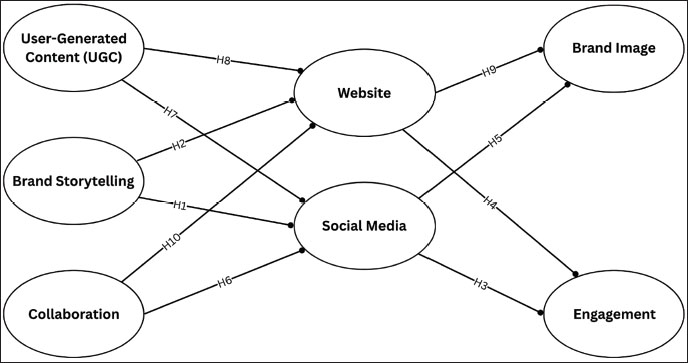
H1: Brand storytelling has a positive relationship with social media usage.
H2: Brand storytelling has a positive relationship with website usage.
Collaboration, Social Media and Websites
In the digital marketing age, where people have a very media-driven lifestyle, marketers have evolved their marketing approach towards the marketplace. Now, the content is generated by popular and influential people posting content on the online space, known as influencers. An influencer is an individual with a large following and has a powerful influence on their followers, their opinions and sometimes their decisions. Celebrities, social media stars, industrial experts, brand ambassadors, content creators—bloggers, videographers/vloggers, artists, podcasters and photographers—are the influencers of the modern marketplace. Influencers, due to their large follower base and niche content creation across social media platforms, foster higher audience interaction and engagement as followers often relate to or aspire to the lifestyles and values reflected in their content (Levin et al., 2025). Previous studies have suggested that collaborations with influencers who create relatable and informative content, particularly when aligned with expert perspectives and consistent with their existing values, enhance authenticity and strengthen audience engagement (Paraskeva et al., 2024). The online industry was initially governed by very niche fashion setters, but now it has opened up. The influencers are the driving force of various categories, such as fashion, tech, beauty, lifestyle and travel, and play a very crucial role in trend-setting. Due to consistent content posting about trends and recommendations, they exert an influential force on their followers to engage with their suggestions (Nurfadila, 2020). Social media and the employment of influencers by brands are a driving force for the purchasing decision of a consumer. Thus, the study hypothesises:
H3: Collaborations have a positive relationship with social media usage.
H4: Collaborations have a positive relationship with website usage.
UGC, Social Media and Websites
Brands may now effectively engage with their audience and create a feeling of community by using UGC (Ploscă et al., 2024). It has the potential to significantly impact brand perception, consumer loyalty, brand image and purchasing decisions in the online space. Gharib et al. (2019) contend that better product development and consumer comprehension can be achieved by studying UGC. Businesses can get insights that guide their product design and development process and result in more effective and relevant offers by analysing the feedback, preferences and experiences that consumers share (Fu et al., 2024). Similarly, Djafarova and Bowes (2021) contend that because of its easily navigable design and freely available UGC, social media, especially Instagram, has grown in popularity as a platform for online purchasing. Because they believe UGC, often referred to as electronic word-of-mouth (eWOM), to be truthful and grounded in real-world experiences, consumers are more likely to trust it than traditional marketing communications. UGC is important to drive customer interaction, shape brand perception and influence purchase decisions (Osorio-Andrade et al., 2025). Through its insights into consumer preferences, UGC helps firms generate more relevant products and improve their product development (Gharib et al., 2019). Furthermore, UGC is beneficial in establishing trust and encouraging customer loyalty because of its authenticity and legitimacy (Djafarova & Bowes, 2021). Even though previous studies have recognised the significance of UGC, there is still a significant knowledge vacuum in understanding how UGC, along with brand storytelling and collaboration, can help generate positive brand engagement and develop brand image on websites and social media. Thus, the study hypothesises:
H7: UGC leads to more social media usage.
H8: UGC strengthens the website’s credibility.
Social Media
Social media has completely changed how companies communicate with their customers. Social media channels present a distinctive chance for brands to interact with clients, increase brand recognition and cultivate customer loyalty. Kim and Ko (2012) state that to sustain an exclusive and appealing image, luxury brands can use social media platforms as a potent tool for storytelling, interaction and communication with their target audience, while Lu et al. (2022) mention that social media has developed into an essential tool for B2C companies to communicate with clients. Crafting compelling communications is still difficult, though. This review of the literature looks at how customer engagement on social media is affected by the message source and message content (emojis vs. objective information). According to available data, the message’s source and content affect consumers’ perceptions and levels of trust, which in turn affects engagement. However, knowledge of how these components work together to promote engagement in a business-to-business setting is lacking. Liu et al. (2020) suggest a technique that combines human judgement with big data from social media networks to enhance demand forecasts for new items. They illustrate the difficulties in accurately classifying social media’s influence factors on demand forecasting, converting insights into judgements that can be implemented and maintaining data dependability. They also show how effective this method is in a real-world scenario. The literature review investigates how social media influences consumer experiences and propels brand success. It emphasises how crucial social media is to the storytelling and engagement of luxury brands, as well as the efficient communication of B2C businesses. However, the study finds a knowledge vacuum on how message source and content interact to shape customer engagement, especially in business-to-business settings. Subsequent investigations may probe this field more thoroughly and examine the enduring effects of social media involvement on customer conduct and brand allegiance.
Websites
In the past 10 years, websites have transformed, becoming a significant element of digital brand strategy, serving as a dynamic platform that shapes consumer perceptions and nurtures brand engagement (Shehu et al., 2021). In the fashion industry, a brand’s website functions as a primary digital touchpoint that has the ability to influence consumer behaviour through visual aesthetics, interactive interface and content framework. A coherent, streamlined website with clear navigations and personalised elements can significantly boost the user experience and nurture consumer retention (Natasha et al., 2021).
As per recent studies, incorporation of brand storytelling, collaborations and UGC into a website design can increase emotional resonance and engagement (Krishen et al., 2021). Similarly, when storytelling is embedded into a brand’s digital interface, it creates a profound psychological connection with the users. Likewise, collaborations on websites provide authenticity and cultural relevance, strengthening user trust and involvement (Yin et al., 2026). In the same way, UGC, on a brand’s website, builds social proof and improves interactivity, demonstrating brand loyalty and authenticity (Jiang et al., 2025).
Thoughtful website functionalities further support brand image formation and sustained engagement (Xu & Schrier, 2019). Through these dynamics, which demonstrate websites as aid to strategic conduit, brands can operationalise their digital narratives and co-create value with consumers.
Social Media, Websites and Brand Image
Brand image is a consumer’s perception of a particular brand, which can be related to the product quality, services or experiences. The online industry is a rapidly growing industry where marketers have to leave a lasting impression to build a good brand image, and this is where engagement and personalisation play their role in building a brand image. Keller (1993) mentioned that the reflection that the consumer holds about a particular brand depends on how they perceive it and what they think about it. Kotler and Keller (2016) believe a brand image to be the way that customers view a company, shaped by things like experiences, services and quality of products. They underline that brand image is vital in creating consumer satisfaction and loyalty. Besides the significant impact of brand image in building loyalty, it holds a major role in creating engagement, which also positively impacts brand loyalty (Kim & Ko, 2012). Prior studies have also validated that the emotional association with a brand strengthens brand loyalty, which the brands leverage for premium prices (Diniso, 2025). Similarly, in the fashion sector, customer engagement and loyalty are greatly influenced by brand image. Customers’ perceptions of a brand are greatly influenced by their experiences, services and product quality. Enhanced consumer satisfaction and loyalty can result from better brand interaction achieved through these components (Orús et al., 2026). Furthermore, brand image enhancement can be achieved through experiences that incorporate components such as UGC (Lanz et al., 2024), brand storytelling (Ahmed et al., 2024) and collaboration (Ika Sari et al., 2024). These tactics in influencing consumer perceptions and emotional ties to the brand have been widely examined in the literature. Through the cultivation of genuine relationships, brands may bolster their trustworthiness and hence cultivate a more positive brand perception. Thus, the study hypothesises:
H5: Social media usage strengthens the brand image.
H9: Websites positively impact the brand image.
Social Media, Websites and Brand Engagement
With the rapid changes in online consumption behaviour, brands are under pressure to provide customers with distinctive and customised experiences. To develop strong brand ties and encourage consumer loyalty, engagement is essential (Aldhamiri et al., 2024). Hollebeek and Macky (2019) argue that relationships, trust and brand engagement can only be developed through digital content marketing. It promotes behavioural, emotional and cognitive engagement through the provision of quality content, which in turn increases favourable attitudes, brand equity and brand trust. Pizzi et al. (2022) suggest that engagement is a multidimensional construct of immersion, passion and activation and that interaction, brand attachment, brand trust and brand knowledge all contribute to brand engagement in the metaverse. They contend that these elements eventually influence consumers’ inclinations to make in-person purchases and are favourably influenced by the immersive experiences provided by the metaverse. Previous studies have observed that if engagement with the content satisfies the motivation, then the content marketing can strongly influence the advertising value (Mirzaei et al., 2024). By examining the distinct engagement drivers, this research aims to close the knowledge gap regarding how these two segments of the market drive engagement through different factors. Thus, the study hypothesises:
H6: Social media usage strengthens brand engagement.
H10: Websites positively impact brand engagement.
Research Methodology
Data Collection and Sample Characteristics
To address our research questions, we gathered data through a survey from individuals in India who are active social media users. We used a convenience sampling approach to reach out to the target population through social media platforms such as WhatsApp, LinkedIn, Instagram and e-mails, asking them to share their perspectives. The survey was done from June to October 2024 to collect the data with the help of a structured self-administered questionnaire (Malhotra, 2004). The questionnaire was divided into two parts: the first being the data about the demographics of the respondents, while the second part addressed the variables of the research model (Table 1), which were measured through a 5-point Likert scale, where 1 represented strongly disagree and 5 represented strongly agree. The power estimation technique was employed to determine the sample size. G* Power software was used for calculating the required sample size. With an effect size of 0.15, a power value of 0.95 and a maximum of 8 predictors, the required sample size was calculated as 74. A total of 154 responses were collected, of which only 137 were selected for final analysis after eliminating incomplete responses, missing values and outliers, and the given sample size is more than the required sample size. These 137 responses were used for final analysis through partial least squares-structural modelling (PLS-SEM) in SmartPLS. Table 1 presents the descriptive characteristics of the sample.
| Numbers | Percentage | ||
| Gender | Male | 77 | 56.2% |
| Female | 60 | 43.8% | |
| Age | Below 20 | 50 | 36.49% |
| 21–30 | 60 | 43.79% | |
| 31–40 | 5 | 3.64% | |
| 41–50 | 15 | 10.94% | |
| 50 and above | 7 | 5.1% | |
| Employment | Entrepreneur | 10 | 7.2% |
| Employee | 22 | 16.05% | |
| Professional | 10 | 7.2% | |
| Home-maker | 3 | 2.18% | |
| Student | 89 | 64.96% | |
| Retired | 3 | 2.18% | |
Measures
The questionnaire’s elements were modified from previously validated scales and adapted for the context of content marketing on online platforms (websites & social media). Brand storytelling has been measured with 5 items adapted from Yu Xie (2021); collaboration with four items adapted from Nataly Levesque and Frank Pons (2020); UGC with three items adapted from Owusu et al. (2016), Nawras et al. (2021) and Dianat et al. (2019); websites with three items adapted from Wang and Tang (2003), Abelse (1998) and Zviran et al. (2006)); social media with two items adapted from Chatterjee and Kar (2020); brand image with three items adapted from Aaker (1996) and Martinez and Chernatony (2004); and engagement with two items adapted from Hollebeek et al. (2014).
Data Analysis and Results
PLS-SEM has been opted for over CB-SEM to handle the complexity of the model involving both reflective constructs, as well as to justify the small sample size of the study (Hair et al., 2020). The analysis of the data has been described in two sections: the first section explains the assessment of the measurement model, and the second section explains the assessment of the structural model.
Measurement Model Assessment
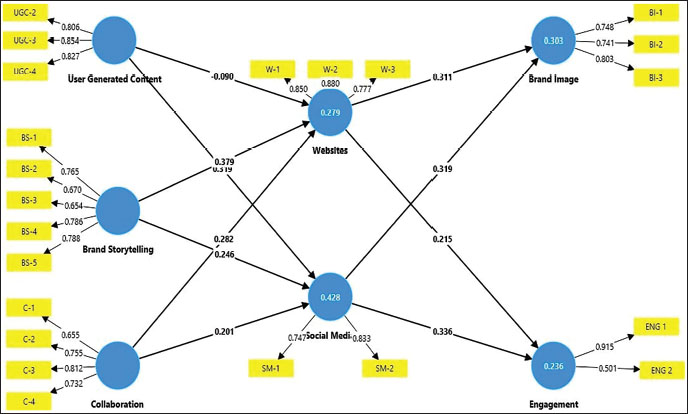
Measurement model assessment measures the reliability, convergent validity and discriminant validity of the model’s constructs. Therefore, the first step evaluated the outer loadings of each item in the reflective measurement model, as can be seen in Figure 2. After removing UGC1, BS 6, SM 3 and ENG 3 one by one, respectively, whose outer loadings were less than 0.708, all the other items were retained, except BS2, BS3, C1 and ENG 2, but as can be seen in Table 3, all the constructs had AVE more than 0.50; therefore, all the indicators were retained (Hair et al., 2020). Thus, indicator reliability was established.
| Composite Reliability (rho_c) | Average Variance Extracted | |
| Brand image | 0.808 | 0.585 |
| Brand storytelling | 0.854 | 0.540 |
| Collaboration | 0.828 | 0.548 |
| Engagement | 0.688 | 0.544 |
| Social media | 0.770 | 0.626 |
| User-generated content | 0.868 | 0.687 |
| Websites | 0.875 | 0.700 |
Note: p < .001.
The next step assessed the internal consistency reliability of each construct through composite reliability values. Table 2 reflects that all the constructs have composite reliability values between 0.70 and 0.90, which is evaluated as ‘satisfactory to good’ as per (Hair et al., 2019) guidelines, except for engagement; however, since its respective average variance extracted (AVE) value is more than 0.50, internal consistency reliability has been established. The third step measures each construct’s convergent validity through AVE, which must be at least 0.50 and above for acceptance (Hair et al., 2019). As can be seen from Table 2, all the AVE values are greater than 0.50, which explain that at least 50% or more of the variation of the items constitutes their respective construct. In the fourth step, HTMT values were calculated to assess the discriminant validity in the outer reflective model. According to Henseler et al. (2015), with a conservative threshold value of 0.85, discriminant validity is established. As can be seen in Table 3, all values lie within the threshold except for cross-loadings of the following constructs: ‘engagement and brand image’, ‘social media and brand image’, ‘social media and collaboration’, ‘social media and engagement’, ‘user-generated content and social media’, ‘website and engagement’ and ‘website and social media’, which are greater than 0.90; hence 10,000 samples bootstrapping was performed to check if the sample mean lies within the 97.5% confidence interval and zero does not lie in between the confidence interval values of 2.5% and 97.5%. As can be seen from Table 4, the sample mean of all the above-mentioned constructs lies between the values of the confidence intervals with no zero in between, as all the values are positive, thus satisfying the requirements for the discriminant validity for the model. Hence, after conducting a confirmatory factor analysis, the results established that the model is fit for conducting structural model assessments.
| Brand Image | Brand Story telling | Collaboration | Engagement | Social Media | UGC | Websites | |
| Brand image | |||||||
| Brand Storytelling | 0.627 | ||||||
| Collaboration | 0.699 | 0.701 | |||||
| Engagement | 1.095 | 0.851 | 0.537 | ||||
| Social media | 0.916 | 0.881 | 0.966 | 1.454 | |||
| User-generated Content | 0.552 | 0.783 | 0.757 | 0.748 | 1.033 | ||
| Websites | 0.640 | 0.556 | 0.568 | 0.923 | 0.909 | 0.390 |
Note: Values in bold on the diagonal are the AVEs using HTMT.
| Original Sample (O) | 2.5% | 97.5% | |
| Engagement <—> Brand image | 1.095 | 0.584 | 3.819 |
| Social media <—> Brand image | 0.916 | 0.628 | 1.410 |
| Social media <—> Collaboration | 0.966 | 0.697 | 1.530 |
| Social media <—> Engagement | 1.454 | 0.777 | 4.833 |
| User-generated content <—> Social media | 1.033 | 0.778 | 1.646 |
| Websites <—> Engagement | 0.923 | 0.388 | 3.164 |
| Websites <—> Social media | 0.909 | 0.597 | 1.449 |
Structural Equation Model Assessment
Through the establishment of validity and reliability of elements of the measurement model, the model becomes fit for structural model assessment for establishing relationships amongst the variables. Therefore, to proceed further, the issue of multicollinearity was addressed, where VIF values of the inner model have to be less than 3.33, and Table 5 reflects that all the values are less than 3, thus establishing that there is no issue of multicollinearity (Henseler et al., 2014). Next, to assess the inter-construct relationships, bootstrapping with 10,000 resamples was performed (Hair et al., 2019). Table 5 explains the significance of the path coefficient and effect size (F2), while Table 6 explains the coefficient of determination (R2). The results indicate acceptance of all hypotheses as they were found to be positively significant, except for H3, H8 and H10, as the value 0 appears between the confidence intervals. Additionally, Table 6 explains the coefficient of correlation of all the dependent variables, that is, R2 reflects on the predictive power of the four endogenous variables, that is, brand image, engagement, social media and websites, where brand image explains 30% of the variance, engagement only 23.6%, dominant 42.8% by social media and 27.39% by websites is explained. As per Cohen (1988), these values are substantial. Also, since the SRMR value is less than 0.08, the fitness of the model has been established.
| Hypotheses | Path | VIF | Path Coefficient | 2.5% | 97.5% | Result | F2 |
| H1 | Brand storytelling –> Social media | 1.784 | 0.246 | 0.038 | 0.411 | Supported | 0.096 [small] |
| H2 | Brand storytelling –> Websites | 1.784 | 0.379 | 0.144 | 0.563 | Supported | 0.108 [moderate] |
| H3 | Collaboration –> Social media | 1.644 | 0.201 | −0.031 | 0.400 | Not supported | 0.038 [small] |
| H4 | Collaboration –> Websites | 1.644 | 0.282 | 0.092 | 0.453 | Supported | 0.019 [small] |
| H5 | Social media –> Brand image | 1.385 | 0.319 | 0.112 | 0.502 | Supported | 0.086 [small] |
| H6 | Social media –> Engagement | 1.385 | 0.336 | 0.174 | 0.464 | Not supported | 0.044 [small] |
| H7 | User-generated content –> Social media | 1.840 | 0.319 | 0.087 | 0.546 | Supported | 0.048 [small] |
| H8 | User-generated content –> Websites | 1.840 | −0.090 | −0.330 | 0.153 | Not supported | 0.051 [small] |
| H9 | Websites –> Brand image | 1.385 | 0.311 | 0.109 | 0.494 | Supported | 0.106 [moderate] |
| H10 | Websites –> Engagement | 1.385 | 0.215 | −0.013 | 0.405 | Not supported | 0.068 [small] |
| R2 | SRMR | |
| Brand image | 0.303 | 0.07 |
| Engagement | 0.236 | |
| Social media | 0.428 | |
| Websites | 0.279 |
Discussion and Conclusion
The results show that social media platforms, particularly Instagram, play a significant role in influencing consumer behaviour and brand perception and consumers strongly believe that fashion brands can increase engagement by prioritising social media marketing, making it the most effective strategy, followed by meaningful brand interactions and building a strong brand image. According to the results, influencer marketing and UGC, such as reviews and social media posts, are important; they are given somewhat less weight than celebrity endorsements, social responsibility programmes and personal interactions.
Nonetheless, social media engagement with brands through the introduction of new products and tailored experiences turned out to be important factors in determining customer satisfaction. It has been determined that elements such as product quality, cost and design have a major impact on how consumers perceive a brand, making them crucial for building loyalty, as per the findings.
The results highlight how UGC, brand storytelling and collaboration shape consumer engagement and brand image on online platforms. Brand storytelling has a moderate impact on website interactions (H2) and a somewhat significant impact on social media (H1), which supports its function in fostering brand image and consumer engagement. These findings are consistent with those of Dolan et al. (2019), who highlighted how well-structured and captivating storylines impact audience engagement.
When it comes to influencing customer engagement and brand image, collaboration produces mixed results. H3 is not supported, implying that collaboration has little effect on social media engagement; however, H4 is supported, demonstrating that collaboration has a good effect on websites as it improves credibility and trust for the brand and sustains a brand storytelling narrative. These results imply that although collaboration works well in controlled settings like websites, it cannot be the main factor influencing participation on dynamic social media platforms (Smith & Taylor, 2019).
Additionally, the impact of social media on brand image (H5) and consumer engagement (H6) is demonstrated. H5 is supported, suggesting that social media, with the help of UGC (supported in results) and brand storytelling, results in higher levels of customer engagement and boosts brand image, which indicates that consumers may prefer consuming such content on social media that they can trust, instead of collaborations where a sign of consumers are pushed to consume content trying to sell a brand/product. This implies that although social media improves brand image, further components like content generated by consumers themselves and emotional associations with a brand through storytelling might be needed for engagement (Kaplan & Haenlein, 2021).
On the other hand, one of the most important factors shaping consumer perception and brand image is UGC (H7) because it provides unbiased views to consumers, demonstrating that UGC has a beneficial impact on social media engagement and strengthens the interactive associations that consumers frame with the brand. However, H8, which proposed that UGC also impacts websites to build brand image and consumer engagement, has been rejected. This implies that UGC has a limited role in static online platforms like websites, in contrast to interactive platforms like social media (Kumar et al., 2020). This can be justified by knowing the essence of UGC, where it requires consumer-brand interactions, which can be noticed more on social media platforms.
Similarly, there are conflicting results from websites and their impact on consumer engagement and brand image. Results for H9 show that websites have a major impact on brand image, highlighting the significance of well-designed digital platforms for the growth of brands (Chaffey & Smith, 2021), which implies that the presence of a well-made brand website can build trust, which transforms into a soothing brand image. However, H10 is not supported, indicating that websites need to incorporate some interactive elements in their websites to increase customer engagement.
The results of the study align with Ajzen (1991), which emphasises how social media usage affects customer attitudes and actions. This study confirms that developing strong relationships with customers and building a positive brand image on digital channels requires meaningful storytelling, regular content distribution and interactive participation. High-quality goods and gripping stories can be combined by brands to produce unforgettable customer experiences that leave a lasting impact for strengthening brand image and encouraging engagement.
In conclusion, this study highlights the crucial role of social media, particularly Instagram, in shaping brand image and consumers’ perception of the brand. Displaying a consistent, engaging and personalised brand storytelling narrative on social media and the website significantly impacts consumer engagement by building a brand image through relatable content.
Today, brands must create a lasting impression, and offering memorable experiences and striking a balance between maintaining a positive brand image and keeping up with continuous consumer engagement and interactions can ensure growth in the respective markets.
Managerial Implications
The findings of this study offer valuable insights for managers and decision-makers in the online industry, particularly leveraging social media marketing to enhance consumer engagement and brand storytelling (Godey et al., 2016). Managers should prioritise social media platforms as key strategic tools for shaping consumer behaviour and brand image (Kaplan & Haenlein, 2010). Focusing on improving UGC through customer satisfaction and frequent personalised social media content updates, and collaboration can boost engagement, create deep brand connections and improve the brand image (Schivinski & Dabrowski, 2016). To keep customers confident and loyal, content must be of the highest calibre, coherently organised and constant (Ashley & Tuten, 2014).
Managers should concentrate on delivering consistent brand stories on all social media platforms to guarantee a seamless consumer experience and strengthen brand image. Managers should especially invest in social media that promotes two-way communication, which can help them deepen customer engagement. Although influencer marketing and UGC may not hold the highest priority, they remain influential in building trust and authenticity (Djafarova & Rushworth, 2017). In addition to encouraging customers to provide evaluations and material that represent their brand experiences, managers should work with relevant influencers (Evans et al., 2017). Managers should combine social media initiatives with e-mail marketing, in-store promotions and loyalty programmes as part of a larger multi-channel strategy to optimise their impact. E-mail discounts that are tailored to a recipient’s social media activity, for example, can increase engagement and conversions (Ashley & Tuten, 2014). By implementing these strategies, brands can strengthen their market position and foster customer loyalty, engagement and sustainable growth in today’s dynamic and competitive digital landscape (Kaplan & Haenlein, 2010).
Theoretical Implications
This study provides crucial theoretical insights into the relation of social media, personalisation, engagement and consumer behaviour. It highlights the transformative role of social media platforms, especially Instagram, in shaping consumer perception of the brand image and driving their buying behaviour (Godey et al., 2016). By examining key dimensions of UGC, such as content quality, consistent content and interactivity, the research expands existing frameworks surrounding consumer experiences (Schivinski & Dabrowski, 2016). The study highlights the importance of relevant, consistent content and fostering two-way communication to improve brand engagement and brand image, effectively blending the concepts of brand storytelling, digital communication (through social media) and consumer engagement (Ashley & Tuten, 2014). Additionally, it also broadens knowledge of multi-channel marketing tactics by showing how social media initiatives can support more conventional platforms like websites to grow on online platforms (Kaplan & Haenlein, 2010).
The differential impact observed across platforms (i.e., social media versus websites) highlights the organismic filtering process within the S-O-R model. The ineffectiveness of UGC on websites, as opposed to social media, underscores that stimulus effectiveness is context-sensitive and moderated by platform-specific features that shape consumer engagement and brand image as a response. Therefore, the study extends the S-O-R framework by emphasising the relevance of authentic content in the form of brand storytelling and user-generated content, acting as a stimulus, generating differing responses of brand image and consumer engagement through different organism contexts, that is, websites and social media. This model focuses on content strategy, which represents platform-specific principles, adaptable to changing technological advances such as AI and others that will follow.
Limitations and Future Research
The study mainly focuses on the impact of certain factors on social media and websites to build brand image and consumer engagement. This research may have overlooked studies on different industries or may have different contexts related to these factors. The data collection is majorly confined to the area of Gujarat, and the audience is available through social media channels like Instagram, Facebook and LinkedIn, resulting in region-specific and platform-specific outcomes; therefore, it is not applicable universally. Also, convenience sampling was used, which may not represent the target audience completely. This article can serve as a foundation for research in the same domain but in different geographical regions.
The authors declared no potential conflicts of interest with respect to the research, authorship and/or publication of this article.
The authors received no financial support for the research, authorship and/or publication of this article.
Shaurya Srivastava https://orcid.org/0000-0002-6863-1357
Aaker D. A. (1996). Measuring brand equity across products and markets. California Management Review, 38(3), 102–120.
Abelse E. G., Domas White M., & Hahn K. (1998). A user–based design process for web sites. Internet Research, 8(1), 39–48.
Ahmed S., Sharif T., Ting D. H., & Sharif S. J. (2024). Crafting emotional engagement and immersive experiences: Comprehensive scale development for and validation of hospitality marketing storytelling involvement. Psychology and Marketing, 41(7), 1514–1529. https://doi.org/10.1002/mar.21994
Ajzen I. (1991). The theory of planned behaviour. Organizational Behavior and Human Decision Processes, 50(2), 179–211. https://doi.org/10.1016/0749–5978(91)90020–T
Aldhamiri A., Carlson J., Vilches–Montero S., Rahman S. M., & Gudergan S. P. (2024). What drives higher active customer engagement in luxury brands’ social media? Measurement and contingencies. Journal of Retailing and Consumer Services, 79, 103804. https://doi.org/10.1016/j.jretconser.2024.103804
Appel G., Grewal L., Hadi R., & Stephen A. T. (2020). The future of social media in marketing. Journal of the Academy of Marketing Science, 48(1), 79–95. https://doi.org/10.1007/s11747–019–00695–1
Ashley C., & Tuten T. (2014). Creative strategies in social media marketing: An exploratory study of branded social content and consumer engagement. Psychology & Marketing, 32(1), 15–27. https://doi.org/10.1002/mar.20761
Brodie R. J., Hollebeek L. D., Juri? B., & Ili? A. (2011). Customer engagement: Conceptual domain, fundamental propositions, and implications for research. Journal of Service Research, 14(3), 252–271. https://doi.org/10.1177/1094670511411703
Chaffey D., & Smith P. R. (2021). Digital marketing: Strategy, implementation, and practice. Pearson.
Chatterjee S., & Kar A. K. (2020). Why do small and medium enterprises use social media marketing and what is the impact: Empirical insights from India. International Journal of Information Management, 53, 102103.
Cohen J. (1988). Set correlation and contingency tables. Applied Psychological Measurement, 12(4), 425–434.
Davies B., Turner M., & Udell J. (2024). The importance of social cues when browsing appearance–focused social media content: A think aloud protocol analysis using fitspiration images and Instagram feed browsing. Media Psychology, 27(3), 352–378. https://doi.org/10.1080/15213269.2023.2242251
de Almeida J. O., Lugosi P., & Quinton S. (2025). Child viewers’ engagement with social media influencers: Exercising socialisation–driven agency. Journal of Business Research, 200, 115590. https://doi.org/10.1016/j.jbusres.2025.115590
Dessart L., & Pitardi V. (2019). How stories generate consumer engagement: An exploratory study. Journal of Business Research, 104, 183–195. https://doi.org/10.1016/j.jbusres.2019.06.045
Diniso C. (2025). The influence of brand awareness, brand image and perceived quality on Generation Y’s brand satisfaction and brand love: A Samsung smartphone case study. African Journal of Economic and Management Studies, 17(1), 104–118. https://doi.org/10.1108/AJEMS–02–2025–0092
Djafarova E., & Bowes T. (2021). ‘Instagram made me buy it’: Generation Z impulse purchases in fashion industry. Journal of Retailing and Consumer Services, 59, 102345.
Djafarova E., & Rushworth C. (2017). Exploring the credibility of online celebrities’ Instagram profiles in influencing the purchase decisions of young female users. Computers in Human Behavior, 68, 1–7.
Dolan R., Conduit J., Fahy J., & Goodman S. (2019). Social media engagement behaviour: A framework for managing customer–brand interactions. Journal of Business Research, 96. https://doi.org/10.1016/j.jbusres.2018.11.045
Dwivedi Y. K., Ismagilova E., Rana N. P., & Raman R. (2023). Social media adoption, usage and impact in business–to–business (B2B) context: A state–of–the–art literature review. Information Systems Frontiers, 25(3), 971–993.
Evan A. G. (2021). How celebrity endorsement influences consumers’ purchase intention of fashion products on Instagram. Indonesian Business Review, 4, 44–56.
Evans N. J., Phua J., Lim J., & Jun H. (2017). Disclosing Instagram influencer advertising: The effects of disclosure language on advertising recognition, attitudes, and behavioral intent. Journal of Interactive Advertising, 17(2), 138–149.
Fu X., Liu X., & Li Z. (2024). Catching eyes of social media wanderers: How pictorial and textual cues in visitor–generated content shape users’ cognitive–affective psychology. Tourism Management, 100. https://doi.org/10.1016/j.tourman.2023.104815
Gharib R., García–Pérez A., Dibb S., & Iskoujina Z. (2019). Trust and reciprocity effect on electronic word–of–mouth in online review communities. Journal of Enterprise Information Management, 33, 120–138.
Godey B., Manthiou A., Pederzoli D., Aiello G., Donvito R., & Singh R. (2016). Social media marketing efforts of luxury brands: Influence on brand equity and consumer behavior. Journal of Business Research, 69(12), 5833–5841.
Hair J. F., Black W. C., Babin B. J., & Anderson R. E. (2019). Multivariate data analysis (8th ed.). Pearson.
Hair J. F., Howard M. C., & Nitzl C. (2020). Assessing measurement model quality in PLS–SEM using confirmatory composite analysis. Journal of Business Research, 109, 101–110.
Hanadi A., & Salhab A. A.–A. (2023). The impact of social media marketing on purchase intention: The mediating role of brand trust and image. International Journal of Data and Network Science, 7, 591–600.
Henseler J., Ringle C. M., & Sarstedt M. (2014). Composite–based structural equation modelling: Assessing high–tech research technology models from a transactional perspective. Springer.
Henseler J., Ringle C. M., & Sarstedt M. (2015). A new criterion for assessing discriminant validity in variance–based structural equation modeling. Journal of the Academy of Marketing Science, 43(1), 115–135.
Hollebeek L. D., Glynn M. S., & Brodie R. J. (2014). Consumer brand engagement in social media: Conceptualization, scale development and validation. Journal of Interactive Marketing, 28(2), 149–165. https://doi.org/10.1016/j.intmar.2013.12.002 https://doi.org/10.1007/s10796–021–10106–y
Hollebeek L. D., & Macky K. (2019). Digital content marketing’s role in fostering consumer engagement, trust, and value: Framework, fundamental propositions, and implications. Journal of Interactive Marketing, 45, 27–41. https://doi.org/10.1016/j.intmar.2018.07.003
Ika Sari G., Winasis S., Pratiwi I., Wildan Nuryanto U., & Basrowi. (2024). Strengthening digital literacy in Indonesia: Collaboration, innovation, and sustainability education. Social Sciences and Humanities Open, 10. https://doi.org/10.1016/j.ssaho.2024.101100
Iveson A., Davvetas V., Hultman M., & Boso N. (2026). Relationship norms, rewards and consumer–brand bonds: When cultural context and attachment anxiety matter. International Marketing Review, 43(7), 1–24. https://doi.org/10.1108/IMR–02–2025–0082
Jiang K., Qin M., Deng D., & Zhou D. (2025). Smile or not smile: The effect of virtual influencers’ emotional expression on brand authenticity, purchase intention and follow intention. Journal of Consumer Behaviour, 24(2), 962–981. https://doi.org/10.1002/cb.2451
JungHwa (Jenny) Hong J. Y. (2022). Sharing consumers’ brand storytelling: Influence of consumers’ storytelling on brand attitude via emotions and cognitions. Journal of Product and Brand Management, 31(2), 265–278. https://doi.org/10.1108/JPBM–03–2021–2920
Kaplan A. M., & Haenlein M. (2010). Users of the world, unite! The challenges and opportunities of social media. Business Horizons, 53(1), 59–68.
Kaplan A. M., & Haenlein M. (2021). Users of the world, unite! The challenges and opportunities of social media. Business Horizons, 64(1), 51–59. https://doi.org/10.1016/j.bushor.2020.09.003
Keller K. L. (1993). Conceptualizing, measuring, and managing customer–based brand equity. Journal of Marketing, 57(1). https://doi.org/10.2307/1252054
Kim A. J., & Ko E. (2012). Do social media marketing activities enhance customer equity? An empirical study of a luxury fashion brand. Journal of Business Research, 65(10), 1480–1486. https://doi.org/10.1016/j.jbusres.2011.10.014
Kosakarika S. (2023). Brand storytelling techniques arousing emotional bonds in different customer groups based on cluster analysis. Kasetsart Journal of Social Sciences, 44(1), 281–292.
Kotler P., & Keller K. L. (2016). Marketing management (15th ed.). Pearson Education.
Krishen A. S., Dwivedi Y. K., Bindu N., & Kumar K. S. (2021). A broad overview of interactive digital marketing: A bibliometric network analysis. Journal of Business Research, 131, 183–195. https://doi.org/10.1016/j.jbusres.2021.03.061
Kumar V., Bhaskaran S., Mirchandani R., & Shah M. (2020). User–generated content and its impact on consumer engagement. Journal of the Academy of Marketing Science, 48(4), 422–448. https://doi.org/10.1007/s11747–019–00706–1
Lanz A., Goldenberg J., Shapira D., & Stahl F. (2024). Buying future endorsements from prospective influencers on user–generated content platforms. Journal of Marketing Research, 61(5), 839–857. https://doi.org/10.1177/00222437231207323
Levesque N., & Pons F. (2020). The human brand: A systematic literature review and research agenda. Journal of Customer Behaviour, 19(2), 143–174.
Levin T., Tiggemann M., Harriger J., & Fardouly J. (2025). The influencer effect: Current findings and future directions for research on social media influencers and body image. Body Image, 55. https://doi.org/10.1016/j.bodyim.2025.102000
Liu X., Burns A. C., & Hou Y. (2020). An investigation of brand–related user–generated content on social media. Journal of Business Research, 106, 4–15.
Lu J., Fan X., & Zhou M. (2022). Exploring B2B customer engagement on social media: Message source and content effects in LinkedIn. Industrial Marketing Management, 102, 514–526. https://doi.org/10.1016/j.indmarman.2022.02.012
Malhotra N. K. (2004). Marketing research: An applied orientation (4th ed.). Prentice Hall.
Martinez E., & de Chernatony L. (2004). The effect of brand extension strategies upon brand image. Journal of Business Research, 57(12), 1340–1350.
Mehrabian A., & Russell J. A. (1974). An approach to environmental psychology. The MIT Press.
Mirzaei A., Wilkie D. C. H., & Burgess A. J. (2024). Does human value–expressive brand anthropomorphism on social media lead to greater brand competitiveness? Journal of Retailing and Consumer Services, 81. https://doi.org/10.1016/j.jretconser.2024.104032
Natasha Zunvindri, & Abdurachman E. (2021). The effects of social media, e–mail marketing, website, mobile applications towards purchase intention–consumer decisions. Proceedings of the 2nd Southeast Asian Academic Forum on Sustainable Development (SEA–AFSID 2018), 168, 10–12. https://doi.org/10.2991/aebmr.k.210305.002
Nurfadila S. (2020). Impact of influencers in consumer decision process: The fashion industry. Interdisciplinary Journal on Law, Social Sciences and Humanities, 1(2), 1.
Orús C., Ibáñez–Sánchez S., & Flavián C. (2026). The impact of creativity in social AR filters on brand awareness, image, and behavioral intentions: The role of intrusiveness and Ad recognition. Technological Forecasting and Social Change, 225, 124521. https://doi.org/10.1016/j.techfore.2025.124521
Osorio–Andrade C., Rospigliosi P. A., & Zarco A. J. (2025). eWOM and content marketing strategies: Maximizing brand engagement among social media users in Spain. European Research on Management and Business Economics, 31(3). https://doi.org/10.1016/j.iedeen.2025.100293
Owusu R. A., Mutshinda C. M., Antai I., Dadzie K. Q., & Winston E. M. (2016). Which UGC features drive web purchase intent? A spike–and–slab Bayesian variable selection approach. Internet Research, 26(1), 22–37.
Paraskeva N., Haywood S., Hasan F., Nicholls D., Toledano M. B., & Diedrichs P. C. (2024). An exploration of having social media influencers deliver a first–line digital intervention to improve body image among adolescent girls: A qualitative study. Body Image, 51, 101753. https://doi.org/https://doi.org/10.1016/j.bodyim.2024.101753
Pattipeilohy V. R., & Riry J. (2019). The effect of celebrity endorsement and brand image on consumer purchase intention on Maspion products in Ambon City. Scientific Research Journal (SCIRJ), VII(IX).
Pizzi G., Mazzucci F., & Scarpi D. (2022). The effect of sensory experiences on purchase intention and on the mediating role of sensory memories. Journal of Consumer Marketing, 39(5), 528–539.
Plosc? T. R., Curiac C. D., & Curiac D. I. (2024). Investigating semantic differences in user–generated content by cross–domain sentiment analysis means. Applied Sciences (Switzerland), 14(6), 2421. https://doi.org/10.3390/app14062421
Schivinski B., & Dabrowski D. (2016). The effect of social media communication on consumer perceptions of brands. Journal of Marketing Communications, 22(2), 189–214.
Shehu E., Abou Nabout N., & Clement M. (2021). The risk of programmatic advertising: Effects of website quality on advertising effectiveness. International Journal of Research in Marketing, 38(3), 663–677. https://doi.org/10.1016/j.ijresmar.2020.10.004
Smith K., & Taylor J. (2019). Marketing communications: A brand narrative approach. Kogan Page.
Tao Chen P. S.–C. (2022). The impact of online reviews on consumers’ purchasing decisions: Evidence from an eye–tracking study. Frontiers in Psychology. https://doi.org/10.3389/fpsyg.2022.814702
Wang Y. S., & Tang T. I. (2003). Assessing customer perceptions of website service quality in digital marketing environments. Journal of Organizational and End User Computing (JOEUC), 15(3), 14–31.
Xie Y. (2021, December). The influence of brand story types on consumers’ brand attitude. In 7th Annual International Conference on Social Science and Contemporary Humanity Development (SSCHD 2021) (pp. 282–286). Atlantis Press.
Xu X., & Schrier T. (2019). Hierarchical effects of website aesthetics on customers’ intention to book on hospitality sharing economy platforms. Electronic Commerce Research and Applications, 35. https://doi.org/10.1016/j.elerap.2019.100856
Yin R. K. (2018). Case study research and applications: Design and methods (6th ed.). Sage Publications.
Zviran M., Glezer C., & Avni I. (2006). User satisfaction from commercial websites: The effect of design and use. Information & Management, 43(2), 157–178.
